Thursday, July 28, 2005

Forever!

vaD joH'a' ghaH QaQ. Daj muSHa'taH pung SIQtaH reH, Daj voqtaHghach Daq Hoch DISmey.
For the LORD is good. His loving kindness endures forever, his faithfulness to all generations. psalm 100:5

podcast version

Some people may remember, when the world waited and worried about Y2K, and when clocks began ticking over - in Australia part of the celebration was emblazoning the word "ETERNITY" in script at the climax of Sydney's New Year's fireworks. Some may have been curious about the story. If they looked into it, they'd have learned about a man, Arthur Stace, who once heard a preacher say "Eternity, Eternity, I wish that I could sound or shout that word to everyone in the streets of Sydney. You’ve got to meet it, where will you spend Eternity?"

Mr. Stace was so taken with this that he took to chalking the word - just that word everywhere on the sidewalks of Sydney.

It is a good word to reflect on - because, looking around the world, and at the works of our own hands, we'll see: nothing lasts forever. And if we think that, the psalmist is there to remind us: we're wrong.

vaD joH'a' ghaH QaQ. Daj muSHa'taH pung SIQtaH reH
For the LORD is good. His loving kindness endures forever

l'olam - is the word behind "forever" here. It means something like unto-the vanishing point; generally, time out of mind, ALWAYS. In the context of this Psalm, it says there isn't a limit to God's love. Without an assurance that God's loving kindness is unlimited a word like "eternity" frightens me - it sounds like extinction. For I see an unlimited future that will swallow up anything I might be or do.

But when I know God' s loving kindness endures forever - then I know I've trusted the one who can bring me through this life, and into that eternity.

Now it is always dicey to make too much of wordplay - especially in a constructed, fictional language like Klingon, but I like this "coincidence." Namely, that the word I've used for "forever" is reH: always. This word is also the word for "play," as in play a game. As I said - don't make too much of this - but isn't it a wonderful thought that - at least in Klingon when we spell out eternity, we may also be looking forward to the delights of playing together in the courts of the Lord.

Sunday, July 24, 2005

Thanks!

'el Daq Daj lojmItmey tlhej tlho'taHghach, Daq Daj bo'DIjmey tlhej naD. nob tlho' Daq ghaH, je ghurmoH Daj pong.

Enter into his gates with thanksgiving, into his courts with praise. Give thanks to him, and bless his name. Psalm 100:4

podcast version

Take a moment to consider the last door you went through. Was it an exit or an entrance? Were you happy or upset to use it? Maybe you didn't notice it at all - it all depends on the circumstances. A child may dread the first day of a new school, may even be dragged into it - yet years later the same student may be more upset to be leaving that place for the last time.

What makes the difference? I think it can be a matter of perspective that comes from our attitude, an attitude that may be tied up in one word: tlho'taHghach - thankfulness.

Go to Tel Aviv, or Jerusalem today and you'll hear this word in the shops and on the street. Between friends or business associates.- the same word used in Psalm 100 - todah - "thanks!".

[People are sometimes surprised that Klingons have some words. Peace is one (roj) and thanks is another. To say "thank you" simply add qa- (the prefix for I - something -you) and add tlho'. qatlho', I thank you.]

To express this word, this idea of thankfulness, I extended the word a bit more: tlho'taH (on going thank-ing) plus the -ghach suffix to make a noun of 'the process of on-going thanks': tlho'taHghach - thankfulness.

Maybe this is a clumsy way to express it, but it is key to the attitude we need when approaching God's lojmItmey, his gates.

There is a Klingon saying that shows a negative attitude about gates - looking at them as EXITs not entrances.

yIvoq 'ach lojmItmey yISam
Trust: but locate the doors.

This counsels that 'gates' are the method to get away if your trust is misplaced. Cynical advice indeed - certainly not built on an attitude of thankfulness.

This is not the Biblical approach. Psalm 100 is about coming to God with joy, with delight, with THANKS. This is not always easy, I admit, yet it is a key that lets us see "Daj lojmItmey," (his gates) as the pathway to delight.

Paul writes something that fits in here when he reminds the Philippians (and us) that the way to peace with God, the way to approach him in prayer - the way to enter his gates - is with thanks:

In nothing be anxious, but in everything, by prayer and petition with thanksgiving, let your requests be made known to God. And the peace of God, which surpasses all understanding, will guard your hearts and your thoughts in Christ Jesus. phil 4:6,7

Wednesday, July 20, 2005

The Stars Salute You!

Hoch QaQ gift je Hoch perfect gift ghaH vo' Dung, choltaH bIng vo' the vav vo' lights, tlhej 'Iv laH taH ghobe' variation, ghobe' turning QIb.

Every good gift and every perfect gift is from above, coming down from the Father of lights, with whom can be no variation, nor turning shadow. James 1:17

PodCastVersion

A reading from the book of James - a fitting source as we pause to honor the memory of James Doohan. James Doohan, who faked a Scottish burr to create one of television's most endearing characters, Chief Engineer Montgomery (Scotty) Scott of the U.S.S. Enterprise, died today at the age of 85.

For this podcast, I want to take a break from our travels through Psalm 100 and offer a few words of thanks to the man who gave us the Klingon language, who gave us the words that are used in the Klingon Language Version.

Although the famous order, “Beam me up, Scotty”, was never given on the show, Doohan’s character, Montgomery Scott, became one of the most familiar, and most parodied, characters in TV history.

Whenever the USS Enterprise was pushed to the limits, he would famously cry: “The engines canna’ take it.” Reliable to the end, however, he ensured that they actually could take it.

But he did more than just create a loveable character. Coming from a background in radio, Doohan was skilled at voice work. In fact he used something like half a dozen different accents when auditioning as Scotty - but settled on the Scottish one since everyone knew a real engineer would have to be a Scot.

Using his considerable vocal skills, Doohan devised the Vulcan and Klingon language dialogue heard in Star Trek: The Motion Picture. Later, professional linguists, particularly Mark Okrand, expanded Klingon into a fully constructed language with a working grammar.

Although Klingon became refined by others, Doohan can be credited with formulating the world’s most popular artificial language — Shakespeare and parts of the Bible have been translated into it - a fact that is no doubt familiar to listeners of this podcast.

As we offer our prayers and sympathies to the friends and family of James Doohan, let us give thanks to him for his gifts and the way he shared them with us.

nIvan Hovmey - the stars salute you,

we might say.

pItlho' 'ej joH'a'Daq bIlengjaj - we thank you, and may you go with God.


This podcast included text and information from TimesOnline, New York Times, and Wikipedia

Saturday, July 16, 2005

Who Made You?

Sov vetlh joH'a', ghaH ghaH joH'a'. 'oH ghaH ghaH 'Iv ghajtaH chenmoHta' maH, je maH 'oH Daj. maH 'oH Daj ghotpu, je the Suy' vo' Daj tI yotlh.
Know that the LORD, he is God. It is he who has made us, and we are his. We are his people, and the sheep of his pasture. Psalm 100:3

There's a joke about a scientist who achieved so much knowledge that he felt that he could do everything - that he was the equal of God. God responded with a challenge - they would each try to outdo the other. God began: he picked up some dirt, added water, molded it in to a human shape and brought it to life.

The scientist nodded to himself, made a few notes, then rolled back his sleeves. As he reached out to gather up some dirt... and God interrupted.

"Oh, no you don't. You make your own dirt."

I think of that joke when I hear the odd expression "self-made man," usually presented in admiration for someone who has accomplished a great deal.

As a term of praise, I suppose it has its place. It is a way to say how much a person has accomplished. But take care if you begin to believe it about yourself. This is a mistake and the psalmist tells us clearly that we can't claim any such thing:

'oH ghaH ghaH 'Iv ghajtaH chenmoHta' maH
It is he who has made us

It is tempting to assume we are on our own - that we can take credit for all our accomplishments. Once, in the heat of battle on Deep Space Nine, Worf remarks that the Klingons have no gods - "we killed them." Bold words, and tempting to some who wish to consider themselves "self-made." But such a notion is founded on an imaginary independance - as if we could somehow make ourselves out of nothing.

The word used here for "made" in Hebrew is "'asah" and is also the verb used in Genesis when we read:

joH'a' leghta' everything vetlh ghaH ghajta' chenmoHta', je, yIlegh, 'oH ghaHta' very QaQ

God saw everything that he had made, and, behold, it was very good (Genesis 1:31)

In the Klingon, I've used "chenmoHta'." chen, build up or take form, then added the suffix moH (cause to) and added one more suffix ta' (did happen) giving
chenmoHta' : did form or create.

One other note of interest in the text. Some translations, notably the KJV say "it is he that hath made us, and not we ourselves," instead of "It is he who has made us, and we are his. " The reason is that the Hebrew word "v'low" can mean "and not" or "and his," depending on the context. This could yield either the modern reading "he made us AND-HIS we-are" or the KJV's "he made us AND-NOT us." Neither translation rules out the meaning of the other - but the majority of translations do not use the negative clause since it doesn't fit in with the parallel construction that follows, "We are his people, and the sheep of his pasture. "


The emphasis is that we are God's handiwork, and that this has a consequence. We are not our own - we are answerable to a maker.

Do you consider this good news? I imagine the Klingon response to be much like our own individualistic one - I AM MY OWN! It isn't easy to give up our autonomy. Yet the psalmist wants us to know we are answerable to a creator. No way can I claim to be "self-made."

And it is good news. If we are responsible to our maker, we should realize that he is responsible for US. He did not make us to be discarded or abandoned. Peter wrote:

trust yourself to the God who made you, for he will never fail you.
(1 Peter 4:19b NLT)


Sunday, July 10, 2005

Now Hiring!

toy' joH'a' tlhej tIvtaHghach. ghoS qaSpa' Daj Daq tlhej bomtaH.
Serve the LORD with gladness. Come before his presence with singing. Psalm 100:2


On my planet, in the hemisphere where I live, it is summer: the time of year for vacations and enjoying times of leisure. Except - if you are a student of a certain age, it is often the time to find a summer job.

Work can be a necessity. Work can be a mission, work can be many things - but most do not do it "with gladness," as this psalm commands. That may be why the current best-seller Joy at Work catches people by surprise - "what, I can have JOY... at WORK?"

Yet an older book talks about the same thing - here in Psalm 100 we're called to a special kind of work - a joyful work, to "serve the Lord." Too often we have the impression that the Bible is a book of doom, when it is far more about joy - the joy that God intends for his people. In the WEB translation alone, the word "joy" occurs over 160 times, compared to "sorrow" which occurs fewer than 50 times. Or look for "glad" (nearly 90 times) compared to "sad" (15 times).

God is hiring. And the work he's calling us to do, is a joyful one to be done tlhej tIvtaHghach with gladness. The word here "gladness" is simchah, and carries the idea of gladness, joy, mirth, and pleasure : hardly a call to drudgery. As Jesus told his followers - it was his intention "that your joy may be made full." (John 15:11, 16:24)

In this verse we can see another case of parallelism, the poetic structure used in the Bible to emphasize an idea, in this case "serve the Lord," and "singing" drives home what our work is to be: delight in worship. By the way, the Hebrew word here translated "toy'" or "serve," abad, is familiar to many: you see it in the name Obadiah and Abdullah, which both mean "servant of God."

This IS our work. In fact, the term "liturgy," used to refer to services of worship, is Greek for "the work of the people": it is our job. And this joyful work isn't a summer job: we're talking about eternity. To serve God, by delighting in his gifts and love toward us. We will serve him, and celebrate - forever - what he has done.

toy' joH'a' tlhej tIvtaHghach. ghoS qaSpa' Daj Daq tlhej bomtaH.
Serve the LORD with gladness. Come before his presence with singing. Psalm 100:2

Wednesday, July 06, 2005

Hooray!

jach vaD Quch Daq joH'a', Hoch SoH puHmey!
Shout for joy to the LORD, all you lands! Psalm 100:1
podcast version

What makes you stand up and cheer?

Sometimes at a ballgame, or in the theater, something happens that surprises and delights you so much that - without thinking about it - you cheer or clap or just shout out your approval. You just HAVE to praise something wonderful.

And that may not be enough. If you're really excited, you'll nudge your neighbor and exclaim "Wow, wasn't that GREAT?!"

That kind of enthusiasm is what the author of Psalm 100 is sharing with us:

jach vaD Quch Daq joH'a', Hoch SoH puHmey!
Shout for joy to the LORD, all you lands! Psalm 100:1


Nobody presents a lecture at the baseball game, giving a detailed reason to express approval. When the ball is hit out of the park, everyone cheers. Likewise, without argument or explanation, this is the kind of direct, spontaneous joy that this psalm urges us toward.

"jach," the Klingon word used here means just this kind of noise: yell, scream, cry out! It is familiar to many Klingon speakers from the common toast "'IwlIj jachjaj," "may your blood scream." That word is very close in meaning to the psalm's Hebrew word, "roua." Used 42 times in the Bible, it means to make a lot of noise. The idea is literally "to break," like to split the eardrums with noise in alarms, or cheers. The context of the psalm makes clear that everyone, everywhere is being commanded to rejoice and cheer because of what God has done.

And - just what has God done?

Now, the subtitle of this psalm is "a psalm of thanksgiving," a powerful theme throughout the Bible. Some take the scriptures mandate to praise as their starting point: if we do this (praise God) , then we will experience divine blessing. Indeed some do find this so, and I rejoice with them.

But you're not likely to cheer if you don't see the homerun, if you don't notice the great play. Part of our responsibility is to watch carefully and appreciate what is going on so we WILL jach vaD Quch - shout for joy - at God's work. "Count your blessing," in other words

And there is more to the duty of believers. When we are blessed, then we can share with others - and when we do - then we've helped give others a chance to be thankful to God.

As Jesus reminds us - give people something to cheer about!:

'ach vaj, chaw' lij wov shine qaSpa' loDpu'; vetlh chaH may legh lij QaQ vum, je glorify lij vav 'Iv ghaH Daq chal.
Let your light shine before men; that they may see your good works, and glorify your Father who is in heaven.

Monday, July 04, 2005

July! Vote For Your Favorite Podcasts!

podcast version

Just a quick reminder - if you're inclined to vote for podcasts, remember that it is a new month at PodcastAlley.com - be sure to stop by and vote for your favorite podcasts. Maybe even KlingonWord!

Sunday, July 03, 2005

Traveling Light!

ghaH ra'ta' chaH vetlh chaH should tlhap pagh vaD chaj journey, except a naQ neH: ghobe' tIr Soj, ghobe' wallet, ghobe' Huch Daq chaj purse,


He commanded them that they should take nothing for their journey, except a staff only: no bread, no wallet, no money in their purse, Mark 6:8

podcast version

Going anywhere this summer? This weekend my family is visiting a comet! As I mentioned before, I've taken advantage of NASA's offer to put names, like those of my family, on board a spaceship.

Space travelers know the value of what Jesus told his disciples: travel light. Pack your bags when traveling through life - but do it with care. Consider what you can afford to carry and what the cost will be.

You might guess I'm a space enthusiast (and you'd be right). Being a mathematically inclined space cadet, I can do some of the calculations regarding spaceflight. It is sobering to realize how much it costs to bring cargo into space. The mass ratio just to get to orbit is around 10:1 - nine pounds of fuel to get one pound of cargo into space. Going to Mars? The total cost could be as high as 43:1! (Take a look at my program "Joyride," http://joyride.mrklingon.org if you want to try some of the numbers yourself.)

"Running the numbers" can illustrate how costly it is to carry too much, even if we're only traveling on this planet. Considering such things can help us take just enough - carry only what we need, not all we MIGHT need..

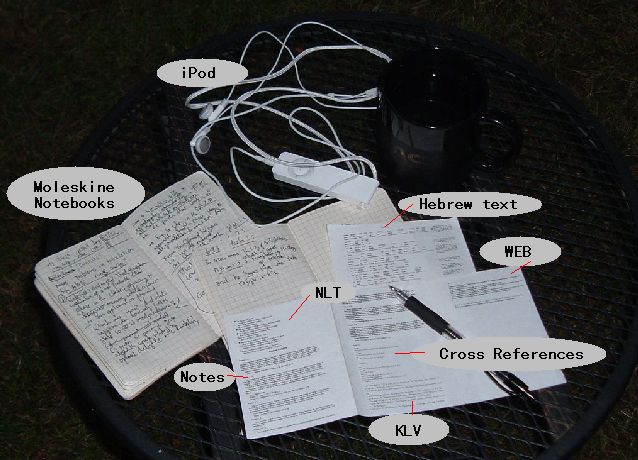
Here's a trivial example of traveling light (yes, this is kind of the excuse for this "holiday travels" podcast) - here's how I work on my Bible studies for these podcasts. I'm fortunate to have plenty of resources - from commentaries and different translations, to a Biblical Encyclopedia. But (considering that I commute to work by bicycle) it isn't practical to carry them wherever I go. I've posted a picture at KlingonWord.org of what I use - take a look; I've found a way to carry "just what I need" in my pocket.


What do you need to work on your podcast? Posted by Hello

Here's what I use to work on the Klingon word from the Word podcasts:


  • Moleskine Notebooks to write in
  • References printed out:

    • Hebrew Text
    • Three translations NLT, WEB, KLV
    • Reference Notes
    • Cross References


The core is, that I use the tools put together by the Crosswire Bible Society. Using their Sword Project, or the Online Bible, I copy into a word processor several translations of the text. I also copy some cross-references and notes from another Bible tool. I print this all small enough that it folds neatly into my pocket note book. Put together, in a package smaller than a passport, I have just enough to take a moment - whenever I have a moment - to work on my studies.

Oh, I'm probably too proud of my mini-Bible library. I enjoy it, and it (for me) is a practical way to do my Bible studies. But in truth, it is so hard to "travel light." I'm at a time in life where I am anticipating the "empty nest" and a house that is too big and filled with far more than I need. We need to pray that God gives us not just what we need - but the wisdom to know what we DON'T.

And traveling light is what we need to do, because we've got a promise that, in the long run, we have nothing to worry about:

'ach nej wa'Dich joH'a' Kingdom, je Daj QaQtaHghach; je Hoch Dochvammey Dochmey DichDaq taH nobpu' Daq SoH as QaQ.

But seek first God's Kingdom, and his righteousness; and all these things will be given to you as well. Matthew 6:33

Saturday, June 25, 2005

Known or Nobody

Podcast Version

Thanks to Think-a-Tron and Digicomp I, I can happily claim to have worked with computers for something like forty years. From the days of those toy computers to today I've used punch cards, paper tape, magnetic tape and disks, compact disks, and now, small flash-ram "jump drives" to store and retrieve information. We've seen the same progress with our music. From vinyl to eight track and cassette tapes to compact disks and mp3 players, every year seems to bring a new way to record our tunes.

We can't imagine what will be used in the future. Though we can assume the obvious: things will continue to hold more and more data in smaller and smaller devices.

Yet these improvements introduce a problem: as older storage techniques become obsolete, we may lose access to important information. It seems funny to think that we have scientific data from the 1960's that is becoming inaccessible. We still possess the records - but as time goes on we're losing the ability to read them.

vaD joH'a' SovtaH the way vo' the QaQtaHghach
'ach the way vo' the mIgh DIchDaq chIlqu'.
For the LORD knows the way of the righteous but the way of the wicked shall perish. Psalm 1:6

To be known by our God - or perish. This is the contrast presented by the last verse of Psalm 1. It is a difference in outcome that I think we see with computers and music. Not many people are prepared to listen to an 8 track, or read a program off of a paper tape: information kept those ways is perishing.

But the things worth knowing, worth keeping, have been preserved. Copied from tape to disk to chips - and who knows? In the future, maybe kiloquad isolinear storage chips, or whatever the Federation uses. As long as the information is kept in a readable form, it won't perish: it will be known.

This psalm was another case where the KLV lexicon needed help. In particular I lacked a word for "perish." abad the Hebrew word, carries the idea of "to wander away, i.e. lose oneself; by implication to perish." So I used the Klingon word chIl, to be lost, and added the intensive suffix -qu'. mIgh DIchDaq chIlqu' : that is, the wicked shall be utterly lost.

What does this mean? I think the Psalm is reminding us that there are two ways ahead of us. As we look through all of our tomorrows and into eternity, what is ahead? Here we see the way of the righteous - the life of the blessed that this psalm describes, or the way of the wicked, those who scoff and turn their backs on God.

To be known and not be discarded - the promise of such a future is the confidence we can find in Psalm 1. There is security in being known by the Lord. It is like the prophet Nahum reminds us:

The LORD is good, a stronghold in the day of trouble; and he knows those who take refuge in him. Nahum 1:7

Wednesday, June 22, 2005

Liftoff!

podcast version

As I write this, space enthusiasts around the world are waiting to hear the fate of Cosmos 1, the first attempt to launch a solar sail powered spacecraft. The prognosis isn't looking too good right now. Almost no communications have been received since launch. Most evidence points to a failed launch - at best a lower orbit than planned. This exciting project used a decommissioned Soviet missile as a launch vehicle and was run by a combination of international teams headed by the Planetary Society. They are pioneering the most efficient technology we know to head out to the planets, and the best to get to the stars!

However, first we have to get the project under way, first we have to - literally - get it off the ground. (Well, okay, off the water - they used a sub to launch the rocket.)

vaj the mIgh DIchDaq ghobe' Qam Daq the yoj
Therefore the wicked shall not stand in the judgment Psalm 1:5

Those words in Psalm 1 speak of "getting off the ground," too. We hear that the wicked shall not Qam or stand (the Hebrew word is quwm which means 'to rise.') In other words, we're talking about rising up, taking one's place: taking a stand. This verse echoes the beginning of the psalm, where we heard that a blessed person won't hang around with the wicked, won't "stand in the way of sinners." Now we hear that - ultimately - the wicked won't stand either. That is, they will not be able to stand alongside the blessed, or be accepted Daq the tay' ghotpu' vo' the QaQtaHghach, "in the congregation of the righteous."

In another psalm we hear the question:

Who may ascend to the LORD’s hill?
Who may stand in his holy place? Psalm 24:3

Who indeed? If we wish to lift off, to rise up before the Lord, and following him to sail beyond merely the planets and the stars, then I think the Psalmist is directing to consider what stand we take in our lives today. We can't do it ourselves. Just as a spacecraft can't get into orbit without a sufficient booster - our ability alone won't lift us up to stand in the judgment.

St. Paul notes this, quoting the Hebrew scriptures, when he wrote to the Ephesians:
That is why the Scriptures say,
'When he ascended to the heights,
he led a crowd of captives
and gave gifts to his people.'

Paul goes on to say:

Notice that it says 'he ascended.'

This means that Christ first came down to the lowly world in which we
live. The same one who came down is the one who ascended higher than
all the heavens, so that his rule might fill the entire universe. Eph 4:8-10 NLT


If you want to rise up, to take your stand with the one whose rule fills the universe - you'll need to follow the advice of Psalm 1: Avoid accepting, and participating with what is wrong. Give your time and attention to the scriptures that tell us what is right.

But your effort isn't enough. We need to accept the gift, the grace of the one who can make us stand, and lift us higher than all the heavens.

Are you ready for liftoff?

Wednesday, June 15, 2005

Blown Away!

The mIgh 'oH ... rur the yub nuq the SuS drives DoH.
The wicked are ... like the chaff which the wind drives away. Psalm 1:4


podcast version

Picture for a moment what you consider to be your enemies. Imagine them before you. Consider those who represent to you, the most formidable villains. This is the wicked, the rishaim in Hebrew, or mIgh in Klingon. These are the adversaries of all that was described in the first three verses of Psalm 1. In this psalm we have read that the blessed person will refuse to join in with the wicked. We've heard that these blessed ones who dwell on God's words will flourish like a well rooted tree. Such a blessed person will endure.

The psalmist now turns back to consider the other side of the coin: the wicked. These are those who rur the yub SuS drives DoH (are like the chaff the wind drives away).

Chaff: Not a familiar term in an increasingly urban world. This verse depends on our knowing that grains like wheat actually have to be processed, crushed so the outer cover of the the grain, this chaff, can be thrown away.

These words assure us that ultimately the threat of the wicked is insubstantial. Their works will not last. Perhaps reflecting on this Psalm, one ancient writer wrote:

"The hope of the wicked is like
thistledown blown by the wind
or like foam blown by a storm.
It is like smoke dissipated by the wind,
It is soon forgotten..." (Wisdom 5:14)
The wicked, however powerful they may seem, will finally be blown away, leaving no trace.

I would say that the duties of believers includes helping one another remember this. We need to support each other in the face of the most crushing defeats of life. Defeats that we cannot always avoid. Remember, the process of separating the wheat from the chaff meant crushing the grain so that the worthless chaff is removed.

The Hebrew word for chaff, mowts, is rendered here with the Klingon word 'yub.' yub refers to something like the rind or shell of a naH, a fruit or nut. It's the part you throw away. And I like to think about how with grain, this "throwing away" is accomplished by simply letting the wind carry it off. It underlines to me how flimsy these enemies, the wicked, ultimately are. Like shutting down a hologram projection, they will be gone completely.

There is more to think about here. The contrast presented, the "wicked" versus the "blessed," represents the choice each of us faces in life. Considering this verse, one writer notes:

"Chaff is very light and is carried away by even the slightest wind, while the good grain falls back to the earth. Chaff is a symbol of a faithless life that drifts along without direction. Good grain is a symbol of a faithful life that can be used by God. Unlike grain, however, we can choose the direction we will take." (Life Application Bible)


yub naH ghap? Chaff or wheat? Which will you, and I, choose to be?

Monday, June 06, 2005

Live Long and Prosper!

'Iv Sornav je ta'taH ghobe' wither. Whatever ghaH ta'taH DIchDaq chep.
whose leaf also does not wither. Whatever he does shall prosper Psalm 1:3b


podcast version

Vulcans are not Klingons. The Klingon language's words for hello (nuqneH) and goodbye (Qapla') translate to "what do you want" and "success." Compare that to Vulcans in whose language the peaceful salute is:

tich tor ang tesmur / Live long and prosper

That sentiment, not often expressed in Klingon, is a good summation of Psalm 1, verse 3: The person who is blessed, who relies on God completely, will live long: ('Iv Sornav je ta'taH ghobe' wither: whose leaf also does not wither). Not having a word for "leaf," we use a compound here Sor (tree) nav (paper). The imagery calls to mind a tree, ever growing, yet never shedding its leaves - the Hebrew, lo yibool, says this tree's leaves don't wilt or fall away.

And this blessed one "prospers": whatever ghaH ta'taH DichDaq chep in all they do, they prosper (NLT).

I think this is an interesting shift in the psalm. We've started speaking of a blessed person, then compared him to a tree and now we hear about "in all they do." Trees don't DO much of anything - they grow, and bear fruit. But they have no plans or tasks to carry out - it is clear we are talking about a person, and what it means for the person who seeks to follow God's word every day.

These verses echo the words of the book of Joshua that promised prosperity to the person who kept God's word always in mind and heart: for then you shall make your way prosperous, and then you shall have good success. (Joshua 1:8)

Now, we must tread carefully with promises like this. It is easy to measure prosperity by wealth or possessions. This is not intent of Scripture. As Jesus said: "what does it profit a man if he gains the whole world, and loses or forfeits his own self?" (Luke 9:25).

And we cannot measure a "long" life by a simple tally of years. Just because I've lived longer than someone doesn't mean my life surpasses theirs. A life can loom large with an impact that far outlasts the days numbered on a calendar. Believers look forward to something more - an existence in eternity, surely the promise that lies behind the psalmist's words.

So, as a Vulcan would say: tich tor ang tesumur - live long and prosper.

This is the path this psalm, indeed all the Bible draws us towards. And, to live long and prosper, we need to seek out the blessed life, a full life that leads to real prosperity: the riches of God's kingdom - forever.

Though a Klingon might not be inclined to say it - if they did read this Psalm, and find these promises here, they might indeed say:

tIqjaj yInlIj 'ej bIchepjaj

Live long and prosper

Thursday, June 02, 2005

Life Signs!

ghaH DichDaq taH rur a Sor planted Sum the streams vo' bIQ
He will be like a tree planted by the streams of water Psalm 1:3a


podcast version

yInroHmey yIHotlh! Scan for life signs!

Anyone familiar with space exploration - particularly as practiced by the United Federation of Planets - knows that this a primary task when discovering a new world or a derelict ship. Facing the unknown, the quest for yInroH, life signs, is job number one.

Even today we see this. The first landers on Mars included automated chemical labs to detect Martian life. Most think this first attempt failed, though there are some who think life was found back in 1976. And now, the ships orbiting and the robots prowling on the red planet continue looking for life signs, especially in the form of water. Simple H20 that covers three quarters of our planet makes life possible on Earth - and it may well be so elsewhere.

What about you? If you are scanned for "life signs," what will be found? "Barren wilderness," "salty flats where no one lives?" That's how the book of Jeremiah describes people "who put their trust in mere humans and turn their hearts away from the LORD." (Jeremiah 17:5 NLT).

In the third verse of Psalm 1, the author leaps from his description of a "blessed" person (doesn't hang out with the evil, dwells on God's word) into pure metaphor:

ghaH DichDaq taH rur a Sor planted Sum the streams vo' bIQ
He will be like a tree planted by the streams of water Psalm 1:3a


This is a good example of how nimbly the Bible can move from simple text into poetry. This picture of the blessed as a Sor, a tree, planted along the water resonates throughout Scripture. Jeremiah seems to quote or reflect these words when we read:

“But blessed are those who trust in the Lord and have made the Lord their hope and confidence. They are like trees planted along a riverbank, with roots that reach deep into the water. Jeremiah 17:5-8a NLT

We seek for life signs, for these waters of life in our own existence. Where I live, it is spring at this moment. I'm sitting writing these words outside surrounded by a world that is green and full of life, a reminder of the kind of life everyone wants to experience.

Jesus speaks of this when he said "the water I give... becomes a .. spring within..., giving eternal life." (John 4:14 NLT )

It will be an exciting day when finally a space probe from Earth finds life out there. Maybe it will be on Mars or Titan orbiting Saturn. Perhaps it will be in a pool, or in some deep underground spring - water teaming with life never seen before.

But right now, today, yInroH wIleghlaH, we can see life signs, within ourselves if only we turn to the one who can lead us to the river of life.

Thursday, May 26, 2005

Mumble & Mutter!


Daq Daj chut ghaH ja''eghqa'taH jaj je ram.

On his law he meditates day and night. (Psalm 1:2b)


podcast version

Okay, I admit it - I talk to myself! (Of course, with a spouse or some other close observer that is the kind of thing that is hard to keep a secret forever. )

I can explain this "talking to myself": it is a useful strategy for pushing things over from short-term memory to the long-term storage. Anyone on the far side of fifty can appreciate this. And it could be worse. I take comfort in something I was once told: "it's okay to talk to yourself - as long as you don't start answering."

"Talking to yourself" is usually taken to mean either you have no audience, or that you're completely cracked. Maybe then it comes as a surprise that Psalm 1 admires just that action - in fact it seemes to be what the Bible admonishes us to do.

Turn to Psalm 1:2 and you'll learn that the blessed person:

ja''eghqa'taH jaj je ram - meditates day and night on God's law

The Hebrew word used here for meditate is "hagah," to murmur - the sense here is to review, rehearse, recite, and remember God's words by saying them over and over to oneself.

Originally 'meditate', not being a common word in the World English Bible (hardly more than a dozen times) was not included in the Klingon Language Version. Since working on these studies, I've added it, using the word "ja''eghqa'" to carry the meaning. "ja'," to report, "'egh," -to-oneself, and "-qa'," again: ja''eghqa': report-again-to-oneself, meditate.

By example, we're told in this psalm that it is vital to "ja''eghqa'" - repeat to oneself - God's word continually.

This is practical advice. Whether a grocery list or God's commandments - repeating the words fixes them in one's mind for easy retrieval. And why would we want to do that? Psalm 119 says it well:

jIH ghaj hidden lij mu' Daq wIj tIq, vetlh jIH might ghobe' yem Daq SoH
I have hidden your word in my heart, that I might not sin against you. Psalm 119:11


This is bedrock: if you want to see the foundations for a life that is ghurtaH Quch 'ej, blessed and happy, you'll find it following this example: continually, recite, repeat, remember - ja''eghqa' God's words, till they become the touchstone by which you can measure and evaluate your life.

In college, I learned about this from a group called the Navigators, who are big proponents of memorizing scripture and meditating on it - they promote ja''eghqa' - though not by that name.

Try it yourself: find a good verse of scripture that speaks to you. Review and review it, till you know it backwards and forwards - I've found you gain more than just knowledge of a few lines of text. Instead you have a resource for your own reflection, ammunition for your own life of prayer. With a vocabulary rooted in the Word, and regular reflection on it, you may experience what is promised in the book of Joshua:

This book of the law shall not depart out of your mouth, but you shall meditate on it day and night, that you may observe to do according to all that is written therein: for then you shall make your way prosperous, and then you shall have good success.
Joshua 1:8

Saturday, May 21, 2005

Delightful Law.

'ach Daj tIv ghaH Daq joH'a' chut.
but his delight is in Yahweh's law
psalm 1:2a


podcast version

Delight. Think for a moment about what gives you delight. Family? Travel? Sports? Chocolate? From deep to trivial, what delights us is as varied as we individuals are. Now, Psalm 1, when it turns from what the happy, the blessed person DOESN'T do, to what they DO do - maybe it comes as a bit of a surprise, when being blessed is tied to finding DELIGHT in LAW.

Law, to me, probably to most people who aren't lawyers - is NOT a subject that quickens the pulse. Yet, in Psalm 1 when we turn to what the blessed DO, we read:

Daj tIv ghaH Daq joH'a' chut - his delight is in Yahweh's law

Part of me rebels at this: "Law? Happiness is bound up in rules and regulations? No, thanks!"

But, wait - this isn't law in the abstract, or in any city, state or national sense. This is joH'a' chut - God's law. This law is charged with a personal quality, a relationship. The specific Hebrew word used here may be a familiar one: Torah. Occurring over 200 times in the Hebrew scriptures, "torah," is commonly used to refer to the "books of Moses," (Genesis, Exodus, Leviticus, Numbers, and Deuteronomy) but carries a much broader idea of God's instruction to his people. The word torah comes from a root, yarah, that means "to throw," the notion being to "throw out one's hand" to point something out, to instruct.

One writer says, "This shows that the end of the Law lay beyond the mere obedience to such and such rules, that end being instruction in the knowledge of God.., and guidance in living as the children of such a God as He revealed Himself to be. " [ISBE]

Part of my problem facing the word "law" here comes from perceiving it as dry words and nothing more. Yes, chut or "torah" encompasses law, as in legal rules, certainly, but also teaching - those things the Lord wants us to be doing. More than rules, this law draws in the whole living testimony of Scripture, set down as a way for us, and, as St. Paul says: " profitable for teaching, for reproof, for correction, and for instruction in righteousness," (2Tim 3:16). What is God pointing out NOW? Where is his hand directing me, TODAY?

Think of it this way: Your walk through life is a path with twists and turns. At times a tough uphill journey, sometimes a breakneck run. Without a companion, someone who can help you along the way, you are likely to get lost, or worse. When we see joH'a' chut, God's law, as the hand of one who walks alongside us in our journey through life, then we'll realize that this path can be an adventure, one where we won't take a wrong turn, nor miss any of the delightful things there are to enjoy along the way.

Monday, May 16, 2005

Don't STAND For It

podcast version

ghurtaH ghaH the loD 'Iv ta'be' ... Qam Daq the way vo' yemwI'pu', ghobe' ba' Daq the seat vo' scoffers;

Blessed is the man who doesn't ...stand in the way of sinners, nor sit in the seat of scoffers; Psalm 1:1b


Ever heard this old joke? "Teacher, should I get in trouble for something I didn't do?" "No, of course not." "Good. I didn't do my homework."

Nice try, but I don't think any real teacher would fall for it. And, it is true - we can get in trouble, not only for what we DO but for what we fail to do.

Psalm 1 shows us what it takes to be a person who is blessed. The author starts by telling us an action to avoid: "following evil advice." But he continues by warning us away from, well something that sounds like "doing nothing." Just being stuck amongst "the wrong crowd." Not DOing anything in particular - just hanging out.

Don't Qam (stand) among sinners, the psalmist says. Why not? Didn't Jesus eat and drink with sinners? The problem isn't meeting or moving among them, the problem is staying put. Yes - Jesus associates with sinners (and don't forget - that means you and me) because, as he says: the puqloD vo' loD ghoSta' Daq nej je Daq toD vetlh nuq ghaHta' lost. ("the Son of Man came to seek and to save that which was lost." Luke 19:10).

In Psalm 1, the warning is getting used to the scoffer - accepting sin as "just the way things are."

Every language contains puns, wordplay that lets you take similar words, or words with multiple meanings to make a point. Klingon is no exception. We can use that to summarize some of this Psalm's advice.

The word for "to emit odor," He' , and "course or route" He are virtually the same. So you might sum up the warning of Psalm 1:1 with:

mIgh HeDaq bIQamchugh vaj mIgh He' DalIjchu'

that is:

if you stand in the evil road (mIgh He), then you will will surely forget the evil smell (mIgh He')


It is easier than we think to get used to things. Staying put, among things we believe in our hearts are wrong may make us lose the perspective we need. The perspective that will make us act in the way that will make us truly Quch - blessed.

And the Psalms have something to say about that, too. We'll move on to the source of that perspective in the next verse of Psalm 1 - stay tuned.

Wednesday, May 11, 2005

Don't Walk!

ghurtaH ghaH the loD 'Iv ta'be' yIt Daq the qeS vo' the mIgh
Blessed is the man who doesn't walk in the counsel of the wicked


podcast version

ghurtaH ghaH the loD/ Blessed is the man

"Bless" is one of those "Bible" words that might seem simple. Bless you! What a blessing! I was blessed. Yet when pressed to define it, it turns out to be a fairly complex bundle rolled up into one simple syllable.

Psalm 1 presents us with a description - maybe a prescription for what it is to be blessed.

There are multiple words in Hebrew, Greek and Latin that are all translated into English as "bless" or "blessed." Now, because the KLV is developed as a relexification (one Klingon term for one English word) of the World English Bible, the text winds up flattening that meaning into a single word: ghurtaH, : on-going increase, that is an increase or benefit to one's material or spiritual riches. In this case, the Hebrew word used in Psalm 1, ashri, means "happy," a translation you will find being used in many modern translations. Eventually that meaning may replace ghurtaH in the KLV, and you'll see the word Quch (happy) used : Quch ghaH the loD.

But what makes a person blessed? ghurtaH or Quch - fortunate or happy - how does one achieve that? This is what Psalm 1 tells us - and it begins by telling us what NOT to do: DON'T WALK.

How obedient are you to those stop lights when they signal walk/don't walk? I was nicknamed "safety frog" by my kids when they were little, since I am such a stickler on safety issues: seat belts, rocket launches and, yes even stop lights. Yet still I get impatient - and sometimes I might dash out and take advantage of a lull in the traffic. But I know those lights have a purpose, and if you blithely ignore them, well, you will be neither ghurtaH or Quch - fortunate or happy.

Iv ta'be' yIt Daq the qeS vo' the mIgh
who doesn't walk in the counsel of the wicked


This is the first of three negatives the psalmist gives us on the way to explain what makes a person blessed. It makes me think of a verse in Proverbs (actually two verses - it gets repeated):

There is a path before each person that seems right, but it ends in death. (Proverbs 14:12 | 16:25 NLT)


I like that description - "a path ... that seems right" : Sometimes doing what you KNOW is wrong IS very tempting. You might want to dash across against the light - and suffer the consequences "it ends in death."

The Bible is realistic: you can't avoid hearing the "counsel of the wicked," whether a classmate telling you how to cheat on a test, or a politician appealing to our personal greed - you aren't at fault for HEARING them.The problem is when we take that first step - when we no longer listen, but begin to walk in their counsel.

As the saying goes "it's no sin to be tempted," the trick is letting it end there. Psalm 1 has much more to say, both what NOT to do, and what we SHOULD do - we'll see more about this in upcoming podcasts. But this is the start, saying NO to qeS vo mIgh (the advice of the wicked). Being Quch, happy, in our life with the Lord begins here. As James reminds us :

".. resist the devil, and he will flee from you." (James 4:7)


So - join the resistance. We've just begin to fight.

Saturday, May 07, 2005

Time To Travel

Hoch the jajmey vo' wIj yIn
all the days of my life


podcast version

News flash! MIT is hosting a Time Travelers get-together May 7th, 2005. Well, maybe this is old news, since by the time you hear this podcast, the event will have happened. Yet, if you are a time traveler, I encourage you to head on over to the the MIT East Campus Courtyard and check it out - I'm sure you'll get a warm welcome.

Time travel can be a pain. Think about the complicated problems you can encounter: DON'T step on a bug - you might wipe out hundreds of species yet to come! Don't prevent your grandparents from meeting or you'll never exist! The list goes on and on - you have to be soooo careful! After all, nobody wants to deal with those agents from the Federation's Department of Temporal Investigations!

Harder still, consider the grammar! How do you explain something you did yesterday - in the future? How do you talk about what you plan to do in the past tomorrow?

Now - we are all time travelers. Not dramatically - not skipping back and forth in a souped up DeLorean, but gradually, daily we sail along into tomorrow:


Hoch the jajmey vo' wIj yIn all the days of my life


so David describes our journey. Dogged by God's grace, by his goodness and loving kindness our travels through time cover this too finite stretch, "the days of our life" - what Psalm 90 estimates to be roughly 70 or 80 years.

And here's the problem with our time travels: The days we're given to live have limit. Even if we see great sites along the way, we know the trip has an end - maybe time doesn't have a limit - but ours DOES.

Yet Psalm 23 points us to a destination, and offers the hope that our short stretch will connect to an unlimited future - David looks forward to
yIn Daq joH'a' tuq reH - live in God's house forever


Maybe you feel like you're going nowhere, moving through each minute, each hour, aimlessly. You travel on through each day, but think there is no destination at the end of your time. Well listen to what Jesus says:

"Don't let your heart be troubled. Believe in God. Believe also in me. In my Father's house are many homes. If it weren't so, I would have told you. I am going to prepare a place for you. (John 14:1-2)

Monday, May 02, 2005

Who's Following Who?

QaQ je loving kindness DIchDaq tlha' jIH
goodness and loving kindness shall follow me


podcast version

The great pitcher Satchel Paige often said “Don’t look back—something might
be gaining on you.”

That doesn't sound like Klingon advice to me. Few would disagree that the straightforward Klingon response to pursuit is to stand one's ground and eliminate trouble before it sneaks up on you!

But these words from Psalm 23 involve a different kind of pursuit; and mark a return in this shepherd's psalm to the picture of God's care as shepherding us, his flock.

Among the tools of a shepherd are herd dogs. We see that God's are QaQ (goodness) and loving kindness - a word not translated in the current revision of the KLV. This word, "Hesed" in Hebrew, is rendered in English translations as 'mercy' or 'loving kindness' and means a deep kind of "covenant faithfulness." The Klingon term batlh (honor) comes to mind as a good translation.

We are pursued by God. His dogs nudge us along the good path and direct us to follow the honorable road - and we will, if only we don't turn on these hounds that are just there to lead us along the best way.

What are these dogs? Or ... who?

In my life, I can picture a whole pack - perhaps you can think of a few in yours. I can see them - friends, family and maybe even strangers who only passed briefly through my orbit. Each one stood as an example, or a reminder of how I might more closely follow God.

And that is the real pursuit we need to consider: God's sheep dogs are there to nudge us on a pursuit of own. If you wonder what that might be, well, the last words that Jesus speaks in John's Gospel spell it out clearly - no matter what language you use:

SoH tlha' jIH.
You follow me.

Friday, April 29, 2005

Running Over Where?

wIj HIvje' qettaH Dung
My cup runs over

podcast version

Half full? Half empty? That evaluation of a partially filled glass is the classic way to measure whether a person is an optimist or pessimist.

Which are you? And what happens when somebody fills the glass SO full it overflows?

That's what David considers in Psalm 23 when he writes:

wIj HIvje' qettaH DungMy cup runs over


God can (and will) bless his people beyond their mere needs. He just will NOT stop!

[My guess, by the way is that the pessismist will gripe about the work cleaning up the over flow, while the optimist delights in the surplus - "aren't we LUCKY to have more than we need?"]

The mechanical process of creating the Klingon Language Version of the Bible involves a simple program that replaces English words with Klingon translations, one word at a time. When that works we get Klingon text arranged in English grammatical fashion - a pidgin Klingon that a translator can polish off. "wIj HIvje'," for "my cup" can be made grammatical by attaching the first person possesive suffix (wIj) to HIvje' (glass, or tumbler): Hivje'wIj becomes a good translation for the Hebrew koesee (my cup).

We're not as lucky with "runs over," since the word "qettaH" means "run or jog". "Dung" means overhead, and was used for the KLV purposes to mean something like "over there." 'My cup runs over there,' does not come too close to the Psalm. Keep this odd wordplay in mind - think of it as "my cup of blessing moves out." I'll come back to that in a moment.

A better translation would be buy'qu' (really full) - HIvje'wIj buy'qu', my cup is really full. Even better, there is a colloquial Klingon expression "buy' ngop" which literally means "the plates are full." It is a way to say "Great news!" A grammatical translation of Psalm 23 might well express the great news of God's generosity, "my cup runs over," with "buy' ngop."

Jesus said: I came that they may have life, and may have it abundantly. (John 10:10b). He wants our lives to be rich and full - not just good enough, but so complete that the bounty spills over! And St. Paul says God can do exceedingly abundantly above all that we ask or think...(Eph. 3:20) God doesn't intend to give us a thimble full of grace.

Everyone does not have a life of overflowing bounty. Every believer does not experience this surplus of blessing. We don't know why - and even beginning to explore the reasons is beyond the scope of this word study.

But those of us who do experience "the cup that overflows" have a different question: what do I do about the spill? Maybe "my cup of blessing moves out" isn't such a bad translation after all.

The faith of the Bible is not a tribal faith. God may have begun with Abraham's family, but God's intention is clear: "All of the families of the earth will be blessed in you."(Genesis 12:3). Jesus made clear that the answer to "who is my neighbor" is EVERYONE. When Jesus gave marching orders he said "You will be witnesses to me in Jerusalem, in all Judea and Samaria, and to the uttermost parts of the earth."

So...

buy' ngop! GOOD news!


If your plate is full, if your cup really runs over, then gather it up. Take your blessings and share them to "the uttermost parts of the earth..."

Better yet, share them "'u' HeHDaq" to the edge of the Universe.