Monday, November 07, 2005

all you peoples!

Extol ghaH, Hoch SoH ghotpu'!
Extol him, all you peoples! Psalm 117:1c

click here for podcast

Forty-two years ago I had traveled around the sun as many times as there were planets: nine. Today, I'd need to live another century to be able to say that. By the time I managed to DO that, (if I could) well, as more telescopes and more observers turn their gaze outward, I expect I'd have to add a millenium or two to keep up.

We live in an unprecedented age of exploration. Besides the 150-plus worlds now known to be circling other stars, we are learning and mapping more about the ones in our own back yard - and there's more than nine! With Sedna, Quoar and Xena we've discovering in what a fascinating neighborhood God has put our little planet.

Looking out into this bustling cosmos, Dava Sobel writes:
Sometimes the stupefying view into deep space can send me burrowing like a small animal into the warm safety of Earth's nest. But just as often I feel the Universe pull me by the heart, offering, in all its other Earths elsewhere, some larger community to belong to.
(Dava Sobel, The Planets)

Extol ghaH, Hoch SoH ghotpu'!
Extol him, all you peoples! Psalm 117:1c

No, the author of Psalm 117 did not know about the worlds of our solar system, nor the worlds beyond. Extol him, all you peoples! Psalm 117:1c But this writer did know about "worlds" of cultures and nations. We've heard the command to all nations to praise God, and here we hear "all you peoples" to extol him.
Extol. Not a common word - in English or Hebrew. The KLV generally only translates frequent words - and "extol" is only used eight times in the WEB. In Hebrew the word here is shabach: to address in a loud tone, and shows up eleven times in the Bible. In the KJV it is translated as commend, glory, keep in, praise, still, triumph. Taking the meaning as "to commend," we might say this in Klingon with "quvmoH," cause to be honored: quvmoH ghaH, Hoch SoH ghotpu' to express this idea to, literally, give a shout-out to the LORD!

The psalmist probably didn't have access to "all you peoples" - any more than we can reach every world that we know about with the good news of God's love. The scope of the universe is so great - there are so many worlds, so many stars, so many people - just on this one planet - that we may feel there is no way we can begin.

Mother Teresa said: We ourselves feel that what we are doing is just a drop in the ocean. But the ocean would be less because of that missing drop.

As much as you can, call out today, SHOUT out today, in joy, in praise, to the LORD. Against the billions on this earth, against the vastness of the Universe and all its countless stars and worlds, this might not seem like much. But it is a start. Let creation, and the creator pull you out into his larger community of praise, to love, to sing and to give thanks!


quvmoH ghaH, Hoch SoH ghotpu'
Extol him, all you peoples! Psalm 117:1c

Monday, October 31, 2005

ALL

naD joH'a', Hoch SoH tuqpu'!
Praise the LORD, all you nations!

click here for podcast

Go outside tonight - or at least the next time you can, when there are stars to be seen.

If the clouds or streetlights make that impossible - go the library and get a book on astronomy, or a download a program like Celestia that lets you explore the sky.

However you do it, look at the stars and think about this word - "ALL." In Hebrew it's col, and here in Klingon we render it as Hoch, a terrific all encompassing word that means "everyone, all, everything." You can't get much more inclusive. Remember - that imperative "hallelujah" is a way of saying "y'ALL praise God."

naD joH'a', Hoch SoH tuqpu'!
Praise the LORD, all you nations!

I don't know that the Psalmist thinks everyone will praise God. What I do think is that the author is filled with excitement and delight at what the LORD has done. The writer of Psalm 117 has that kind of devotion that just spills over and calls out to everyone near and far, to all to Hoch, to praise God.

When you look out into the stars, and think of the countless worlds that lie out there, the call to all to praise God takes on an incredible scope. But it gets better.

You see, there are no boundaries, no borders in a faith that has that kind of excitement. The faith of the Bible is not a local faith. Though it seems national with Israel, or ethnic with churches that grow out of different language groups, when we read this Psalm, we call out Hallelujah! to all. The borders are gone.

Astronauts and cosmonauts have a different perspective than those of us on the ground. They've travelled out into the black of space - and when they look back they've been struck by something - "there aren't any lines," they've commented. We spend our lifetime seeing the world in terms of maps with carefully drawn lines - and once they get out beyond our atmosphere - it's clean. Those borders - for which so many have fought and died - are just gone.

Look out into the sky - the scope and breadth of the Universe tell us God's got no limits. We can delight in his grace, in the marvels of his creation and let our imagination take flight. With a Biblical faith, with a heart filled with praise to our maker as this psalm calls out, we can erase whatever boundaries separated us from each other and call, to one

and to ALL

Praise ye the LORD!

Monday, October 24, 2005

One Word to Bind Them All

naD joH'a'
Praise the LORD
Psalm 117:1a


click for podcast

Would you like to be a linguist, with a vocabulary that extends from Albanian to Xhosa? With one word I can assist you towards this goal.

The word I'm thinking of is at the heart of this Psalm, the shortest chapter of the Bible.

Hallelujah

That short phrase, almost a contraction, ends this psalm, and is expressed in a longer version, hallelu et adonai - praise you the LORD - at the beginning. By bracketing this short chapter, this command directs believers to be about the serious, and delightful, work of praise.

From Hebrew to Greek to Latin, Hallelujah over the centuries was transliterated from language to language and has become an exclamation of praise, so universal that it has moved into the lexicons of many languages. Look for yourself at the Crosswire Bible Society's website, www.crosswire.org/study. There you can compare Bibles in quite a few languages and see this Psalm containing "Hallelujah" or "Allelulia" : Afrikaans, Bulgarian, Croatian, Dutch, Esperanto, and Finnish to name a few, each transliterating this word for their tongue.

But. Not Klingon. If we were to present a Klingon version of Hallelujah, it might be 'alayluya. However, since the World English Bible, the source used for my Klingon Language Version, translates the Hebrew terms, the KLV does likewise, naD joH'a'. If we were to translate it more grammatically we'd say it as a command, joH'a' penaD, the-LORD you-all-praise.

Hallelujah

I love this word, and especially like thinking about the path it has taken through the long years. It is now almost a password, if you will, for believers on every continent and with many different languages. A foreign word in almost every language, it is testifies to a faith language of the heart that is (or should be) a native language for everyone who follows the God of the Bible.

To me, the really important thing is that little syllable -lu-; it indicates the plural. YOU-ALL give praise, not "you" singular. (This is something we've lost in modern English; an ability to easily distinguish singular and plural. You can see it preserved in the King James and Douay translations, where the "you" and "ye" forms indicate plural, and "thou," "thee," and "thine" refer to the second person singular.)

That "lu," Halle-LU-jah, takes the command to praise and extends it not to you or me, but to all of us, together. God calls forth, across the ages, across the world (even to the stars?) and draws us together as we praise him.

Think of this word and all its forms as being links that bind us together when we - all of us - rejoice in any language: Afrikaans, Albanian, Bulgarian, Croatian, Dutch, Esperanto, Finnish, Greek, Hebrew, Klingon, Latin and Xhosa we'll together call out

Hallelujah, allelulia, Praise ye the LORD.

Monday, October 17, 2005

Waiting Room

loS vaD joH'a'
Wait for the LORD Psalm 27:14


I am famous (or notorious) in my family because I rarely go anywhere without a book tucked in my pocket.

"You never know," I joke, "when you might be abducted by aliens. I just want to be prepared to have something to read!"

A more practical consequence is that I am the "designated wait-er" in the family. Everone knows that I am ready to amuse myself standing in line at a cashier or return desk. I don't mind waiting, because I am ready to make good used of my time. (As a matter of fact, I'm writing this, waiting at the Mall of America for some family members who are out doing some shopping.)

The Klingon word here "to wait" is "loS" (and same word as the number "four"). The WEB uses 'wait' over 120 times in the Hebrew scriptures, in this case it stands for the Hebrew word qavah. Used more than 40 times, qavah has the idea of 'to bind' together (perhaps by twisting), i.e. collect. Figuratively, meaning to expect: the King James translates it as gather, look, patience, tarry, and wait.


loS vaD joH'a' Wait for the LORD,

David writes - telling us to taH HoS, be strong.

I don't think David is just saying "tough it out." There is value in learning patience, but there is also value in what we learn as we wait. This is more than pulling out an SF book in the checkout lane.

If you've ever travelled the same route at different speeds - driving versus walking, or flying versus driving to the same destination - you probably noticed that - well, you NOTICED more when you travelled more slowly. Sometimes this is what we need; it's what God helps us find when we need to wait.

Likewise, there are treasures out there to discover when God makes us wait for His answers to our prayers.

David knew this. He was anointed to be King when a teen - yet he had to wait, and he learned to taH HoS, be strong. Not until he was 30 did he truly become king - ready at last, schooled through the years of waiting. Is there any doubt he was far better prepared for the trials he endured?

What are you waiting for? Our times of waiting can be hard - trying our faith. If you stand alongside a friend or loved one who is in their time of waiting, be careful! Do what you can to strengthen them - "let us consider one another," says the author of Hebrews.

And if you wait - as much as you can - give thanks for the gift you may find in this time!

Wait patiently for the LORD.
Be brave and courageous.
Yes, wait patiently for the LORD (Psalm 27:14 NLT)

Friday, October 14, 2005

Allegiance


jIH 'oH vIHHa' voqtaHqu' vo' vam: jIH DichDaq legh the QaQ vo' joH'a' Daq the puH vo' the yIntaH.

I am still confident of this: I will see the goodness of the LORD in the land of the living.
(Psalm 27: 13)

podcast

Where do you live? Or, more specifically, to whom do you owe your allegiance? Allegiance, what the American Heritage Dictionary calls "Loyalty or the obligation of loyalty, as to a nation, sovereign, or cause," is something you can choose to give. Who has yours?

Anyone who knows the history of Lt. Worf and his career on the Enterprise, as well as later on Deep Space Nine, can see the problem of loyalty being divided. A Klingon, raised and educated by humans, Worf always had to face people who questioned where his loyalty, where his allegiance was placed.

But it is a question for all of us - to whom do you owe your allegiance?

Here, almost at the very end of Psalm 27, we hear David confidently say he will see God's goodness, puH vo' the yIntaH, in the land of the living.

Now it is obvious, when David says the eretz hayim,“land of the living," he is talking about “this life.” Despite being in the middle of problems (look back over the text of Psalm 27) he was sure that in this present life, God would see him through it. Yet, I think there is a statement of allegiance here - a trust too - that David's home is "the land of the living." It can be ours too.

Faced with a challenge about survival beyond death, Jesus said:
haven't you read that which was spoken to you by God, saying, 'I am the God of Abraham, and the God of Isaac, and the God of Jacob?' God is not the God of the dead, but of the living." (Matthew 22: 31b,32)

Believers may say this too - by putting our allegiance with this great God and - to trust that God will bless us in the land of the living. No - it doesn't mean everything will be perfect, all ills healed or that all material prosperity will be ours. But trusting this God means our life, our living, will never really end.

Worf, David, you and I need to choose every day who gets our loyalty, what our heart's homeland really is. If we accept the limits of this world, of no more future or survival than the grave, then we're not pledging our allegiance to the land of the living.

The Life Application Bible notes:
God doesn’t force his will on anyone. He lets us decide whether to follow him or reject him. This decision, however, is a life-or-death matter. God wants us to realize this, for he would like us all to choose life.
As Moses said:

Today I have given you the choice between life and death, between blessings and curses. I call on heaven and earth to witness the choice you make. Oh, that you would choose life, that you and your descendants might live! (Deuteronomy 30:19)

Saturday, October 08, 2005

Good Eyes!

ghaH 'Iv ghajtaH a generous mIn DichDaq taH ghurtaH; vaD ghaH shares Daj Soj tlhej the mIpHa'.

He who has a generous eye will be blessed; for he shares his food with the poor. Proverbs 22:9

podcast

I've just discovered WordSpy.com a collection site for new words and phrases.

Words are (obviously) a hobby of mine so I love how WordSpy.com tracks new words. The one that caught my attention lately was joy-to-stuff ratio (joy-too-STUF ray.shee.oh) n. The time a person has to enjoy life versus the time a person spends accumulating material goods.

What a challenging way to measure my life! AND... I think it's Biblical.

Good Eyes! In my family we call that out when someone spots something important - an overlooked item when packing, or say a misplaced pair of sunglasses. Whatever it is, we acknowledge the good observations with that praise.

Today's verse lauds "good eyes," too, believe it or not. But the eyes are those that look to the needs of others, not forgotten luggage.

I'm taking this detour from our almost completed transit through Psalm 27, because the verse caught my, uh, eye, the other day. In fact I know exactly which day, since often I'll read the current day's numbered chapter of Proverbs (eg. chapter one on the 1st, two on the 2nd, and so on).

On the 22nd of September this lead me to the arresting:

ghaH 'Iv ghajtaH a generous mIn DichDaq taH ghurtaH; vaD ghaH shares Daj Soj tlhej the mIpHa'.

He who has a generous eye will be blessed; for he shares his food with the poor. Proverbs 22:9

Now - there is no word in Klingon for "generous." That's okay - the original text doesn't say generous either - it says "tov," good. The same word as God declared over creation when he "saw everything that he had made, and, behold, it was very good." (Gen 1:31).

So we're told the person with the "good eye" (the bountiful eye, the the KJV reads) will be blessed. The phrase that follows spells out what the "good eye" means - "he shares his food with the poor."

Having a QaQ mIn, a good eye, is vital- it helps us see what we need to do. I do find it far easier to look past the front page to the comics - to watch the sitcoms instead of the news. Who wants to see what is wrong?

Well, I think that is the point. If I see what I need to do, and share my "bread" - giving it away, what will that leave me? Blessed.

If we see so clearly, then maybe we can live up to this description in Isaiah

For you have been a stronghold to the poor, a stronghold to the needy in his distress, a refuge from the storm, a shade from the heat, when the blast of the dreaded ones is like a storm against the wall. Isaiah 25:4

How's your joy-to-stuff ratio? I can see mine needs work.

Saturday, October 01, 2005

Speedy Delivery!

yImev toD jIH Dung Daq the neH vo' wIj jaghpu'
Don’t deliver me over to the desire of my adversaries (Psalm 27:12)


I have discovered a revolutionary communciations tool - one that quickly and cheaply moves messages and packages - the MAIL!

My youngest child just started school at an out of town college and we have been having fun sending her notes and occasional packages. We're enjoying how easy (and fast!) it is to keep in touch this way. Of course we've got all the other ways to keep in touch. Email, cell phones and Instant Messages and they are good, but being able to routinely deliver things (letters, cookies, USB drives) is something we never used (or needed) when our son attended a local university and lived at home.

DELIVER: that's the Klingon word to consider today.

The word that David uses in this psalm when he says " Don’t deliver me over to the desire of my adversaries" is nathan, and it means "to give." It is the root of the name Nathan (gift), Nathaniel (God's gift) and Jonathan (The LORD's gift).

However, the mechanical process I used to transform the World English Bible with Klingon vocabulary maps a single English word to a Klingon term. "Deliver " occurs over 200 times in the WEB, both meaning "deliver" as in 'delivering the mail' and 'delivering me from trouble.' The first three occurences are in Genesis, and each translates a different Hebrew word: "deliver me from the hand of my brother" (natsal - to snatch away, 32:11), "that he might deliver him out of their hand" (shuwb - to turn back, 37:22), and "I will deliver your brother to you" (nathan - to give 42:34). Two out of three encompass the notion of rescue.

By not using the Klingon word for deliver, as in delivering a package (HIj), the translation introduces a bit of wordplay to this passage. Using "toD," (to save) I seem to have David not just saying "don't hand me over" to my enemy, but "don't save me for my enemy's evil plans."

There ARE times when we feel this is what is happening. The Israelites, when fleeing from the Pharoah, ignored the way they'd been freed from slavery and complained to Moses: "Because there were no graves in Egypt, have you taken us away to die in the wilderness? Why have you treated us this way, to bring us forth out of Egypt" (Exodus 14:11).

Is this your fear? There are times when we cannot see how God is doing good in our lives. That's why we need to recall Scripture's words of promise. Jesus said he "didn't come to destroy men's lives, but to save them." (Luke 9:56). And he promised to his followers "I came that they may have life, and may have it abundantly." (John 10:10b)

You've got mail! Day after day there are messages - being delivered to you on paper or computer screens. Not all are welcome - but the best delivery is the words from God's word that bring you good news:

For I know the plans I have for you,” says the LORD.
“They are plans for good and not for disaster, to give
you a future and a hope.

In those days when you pray, I will listen.

If you look for me in earnest, you will find me when you seek me."
(Jeremiah 29:11-13 NLT)


Monday, September 26, 2005

Driving Instructions

ghojmoH jIH lIj way, joH'a'. Dev jIH Daq a straight path, because vo' wIj jaghpu'.
Teach me your way, LORD. Lead me in a straight path, because of my enemies.

podcast

At some point in their career, every starship pilot, every driver, every bicycle rider needs the same thing: driving instructions. At some point you have to learn how to do it. How to steer, how to set your course, and how to correct for errors when you make a mistake.

And David knows he needs the same thing in life - driving instructions:

ghojmoH jIH lIj way, joH'a' / Teach me your way, LORD

What kind of a way or path is David looking for? In Hebrew the word is miyshowr , and means "straight" or "plain" - it's used to mean a flat place, (the King James uses this meaning, saying a"plain path") - but the meaning encompasess more. It can stand for concord; also straightness, i.e. (figuratively) justice. Modern translations take the meaning to be "straight." The Douay following the Latin version picks up the idea of the "direct," the best, or RIGHT way: guide me in the right path.


Now, David has a reason for looking for this kind of path. It has nothing to do with saving time, or avoiding fuel bills. It is because

vo' wIj jaghpu'
of my enemies.

Avoiding your enemies may imply being subtle, or roundabout. With an enemy laying down fire, I picture the hero dodging back and forth in a serpentine pattern. But David doesn't say "show me how to hide" - he asks for the right path, the direct route. Because of his enemies, he wants to take the direct route.

What path do we choose to take.? I know that at times it feels far easier to turn away from confronting troubles, from being direct with enemies or trials. But I think David knows that only postpones the problem - it doesn't solve it. A popular book by David Allen is called "Getting Things Done." I've got it (because I need it) and it reminds me of what I think David the psalmist is asking God to help him accomplish: to be direct, go straight to the next task.


Maybe you're looking for driving instructions - maybe you want to find that right path. I think David would happily point us to these words from Proverbs:


Daq Hoch lIj Hemey acknowledge ghaH, je ghaH DichDaq chenmoH lIj Hemey straight.
In all your ways acknowledge him, and he will make your paths straight. Proverbs 3:6

Thursday, September 22, 2005

Asking for Directions

ghorgh wIj vav je wIj SoS lon jIH, vaj joH'a' DichDaq tlhap jIH Dung.
When my father and my mother forsake me, then the Lord will take me up. Psalm 27.10

podcast

What's up? Usually a question into "the general state of things," however when we read God will tlhap jIH Dung, take me up - we can well ask, what does "up" mean?

The Klingon word used, "Dung," really is a noun for "the area above" or "area overhead." I use it in the KLV to stand in for a number of words: above, over and up.

But the words here really represent the Hebrew word 'acaph - used over 150 times in the Bible. It means "to gather" - as simple as bringing things together. It may be as simple "gathering" food. Or it can mean death, as in describing the passing of Aaron, saying he "shall be gathered unto his people." Used here more tenderly, it suggests "hug" or "embrace." But rather than directions, the verse is about something else: abandonement.

The "worthy orphan" in literature ranges from Oliver Twist or Anne Shirley, to Harry Potter, and is a familiar figure. A popular subject in fiction is the child bereft of any family who manages by luck and effort to thrive and succeed. The Bible concerns itself with the orphan also - not to spin a story, but to direct our attention in TWO directions - up, and out.

The book of James says:

Pure religion and undefiled before our God and Father is this: to visit the fatherless and widows in their affliction, and to keep oneself unstained by the world. (1.27)


The believer who cannot direct his or her attention out to the needs of others must measure their faith against that rule. Can we be faithful toward God if our attention is more directed to protecting our own interests? We have to move out and defend those who have the least, as the Bible puts it: The widows and the orphans.

And... we need to look up.


ghorgh wIj vav je wIj SoS lon jIH.
When my father and my mother forsake me


this psalm reads. Not saying parents WILL all forsake their children, but reminding us that even the best parent is mortal, will not be able to do everything.

When those we depend on - parents, friends, and family fail, then David reminds us here

joH'a' DichDaq tlhap Dung
God will take me up.

What a comfort!

Forsaken? Friendless? There is still one who you can turn to - ready to lift you up, and help you, when you turn to Him.

Monday, September 19, 2005

God's Commandments

yImev So' lIj qab vo' jIH. yImev lan lIj toy'wI' DoH Daq QeH. SoH ghaj taH wIj QaH. yImev abandon jIH, ghobe' lon jIH, joH'a' vo' wIj toDtaHghach.

Don't hide your face from me. Don't put your servant away in anger. You have been my help. Don't abandon me, neither forsake me, God of my salvation. Psalm 27:9

Podcast Version

Commandments and religion seem to be natural partners. Virtually every faith expresses, in some way, commands that followers are expected to keep. Usually these commands flow from the divine to the human.

Yet this verse reverses that direction. calling out to God in words that echo the "thou shalt not"s of the ten commandments. These commands however, are directed to God:

  • Don't hide from me
  • Don't put your servant away
  • Don't abandon me.

Does this make sense? Who tells God what to do?

Now Klingons, who supposedly "killed" their Gods, might be thought of as being happy to tell God where to get off - though I think that claim was bravado, not fact. Wanting God to "leave us alone" is natural - usually because in our pride we think we don't need him. Or because we'd rather he didn't get in our way when we want to do something particularly shabby.

But look at these "commands" from David, and you see a different story. Scripture shows humans call out commands - not to dispense with God, but because they know how desperately they need him!.

Just doing the most cursory of searches in Psalms, I found nine passages saying to God

Don't hide, Don't put your Servant away, Don't forsake,
Don't be far, Don't delay, Don't let those who wait be shamed, Don't remain silent.
[For readers, here are those examples:
  • 27.9 Don't hide your face from me. Don't put your servant away in anger. You have been my help. Don't abandon me, neither forsake me, God of my salvation.
  • 38.21 Don't forsake me, Yahweh. My God, don't be far from me.
  • 40.17 But I am poor and needy. May the Lord think about me. You are my help and my deliverer. Don't delay, my God.
  • 55.1 Listen to my prayer, God. Don't hide yourself from my supplication.
  • 69.6 Don't let those who wait for you be shamed through me, Lord Yahweh of Armies. Don't let those who seek you be brought to dishonor through me, God of Israel.
  • 70.5 But I am poor and needy. Come to me quickly, God. You are my help and my deliverer. Yahweh, don't delay.
  • 71.12 God, don't be far from me. My God, hurry to help me.
  • 102.18 Yes, even when I am old and gray-haired, God, don't forsake me, until I have declared your strength to the next generation, your might to everyone who is to come.
  • 109.1 God of my praise, don't remain silent,
]

And this is right, this is what we'd expect of people in a living relationship with the Almighty. Just as in a family or a friendship, there is give and take - a bond that tells EACH member they can call out when they are in need. Certainly it can sound like commands - for all that, we may indeed feel we ARE commanding God when we call out to him. But why not? After all, this is what scripture tells us to do. As Paul wrote to the Philippians:

In nothing be anxious, but in everything, by prayer and petition with thanksgiving, let your requests be made known to God.

And the peace of God, which surpasses all understanding, will guard your hearts and your thoughts in Christ Jesus. Philippians 4:6,7

Monday, September 12, 2005

Liberal Klingons?!?

The liberal qa' DIchDaq taH chenmoHta' ror. ghaH 'Iv bIQmey DIchDaq taH watered je himself.


The liberal soul shall be made fat. He who waters shall be watered also himself.
Proverbs 11:25


podcast version

There's no Klingon word for liberal. That's okay, and you shouldn't draw any political conclusions - there's no word for conservative either. And it isn't that surprising - the limited vocabulary we have for thlIngan Hol often necessitates that we translate around the limited dictionary, coming up with extended phrases or constructions to represent a concept in English.

I'm taking this diversion from Psalm 27 because this weekend, while listening to a podcast (yes I LISTEN to them, too) I heard an interesting comment: "all floods are liberal," meaning that disasters like Katrina remind people of the liberal ideal of providing aid and support to those who are in desperate need.

"What does the Bible say about that?" I asked (I'm told I often talk to myself, but I was mowing the lawn at the time, so I figured I could get away with it).

Well, I found that in the World English Bible the word "liberal" only appears once (four times in the KJV; "conservative" appears in neither translation). So it's natural that the KLV doesn't include the word - my translation tables originally only included words that appeared more than 100 times. As time has gone on, I've gone beyond that - but there aren't many (if any) "only-occurs-once" words.

The Hebrew word used here is brakah, meaning benediction; by implication prosperity. In other contexts (it appears over 60 times) it is often translated blessing - the idea is one of receiving the grace, the blessing of another's (usually God's) generosity. In the context of this verse a Klingon word might be nobtaHqu' - "on-going giving in the extreme."

The great preacher, Charles Spurgeon, reflected on this verse, saying:

We are here taught the great lesson, that to get, we must give; that to accumulate, we must scatter; that to make ourselves happy, we must make others happy; and that in order to become spiritually vigorous, we must seek the spiritual good of others. In watering others, we are ourselves watered. How? Our efforts to be useful, _bring out our powers for usefulness_. We have latent talents and dormant faculties, which are brought to light by exercise. Our strength for labour is hidden even from ourselves, until we venture forth to fight the Lord's battles, or to climb the mountains of difficulty. We do not know what tender sympathies we possess until we try to dry the widow's tears, and soothe the orphan's grief. ...


Our own _comfort is also increased_ by our working for others. We endeavour to cheer them, and the consolation gladdens our own heart. ...

Here's the point: current disasters, like Hurricane Katrina, give us an opportunity to experience this. We have a chance to give - our prayers, our time, our material gifts - and give liberally. I need to remind myself this every day, and I need to hear scripture remind me that the cost will be repaid in tremendous spiritual riches.

Having a word in your dictionary isn't the same thing as having it in your heart. I don't know if Klingons need the word liberal. But I do know, when it comes to how I give to others - I need it.


nob, je 'oH DichDaq taH nobpu' Daq SoH QaQ juv, pressed bIng, shaken tay', je running Dung

Give then, and it shall be given unto you, good measure, pressed down, and running over. Luke 6:38

Saturday, September 10, 2005

Snipe Hunt!

ghorgh SoH ja'ta', " nej wIj qab," wIj tIq ja'ta' Daq SoH, " jIH DichDaq nej lIj qab, joH'a'."

When you said, "Seek my face," my heart said to you, "I will seek your face, O LORD."
Psalms 27:8

Have you ever been on a snipe hunt? Or... sent someone on one? Usually they are a futile quest; the snipe hunt is used to haze newcomers - sending the victim off to "find" a nonexistent goal. Boy Scouts might tell inexperienced campers about a bird or animal called the snipe as well as a (usually ridiculous) method of catching it, such as running around the woods carrying a bag or making strange noises. Since the supposed snipe doesn't exist, the hunt never succeeds, no matter how foolishly the newcomer acts.

Hard to imagine a Klingon accepting such humor gracefully. At least it seems likely that the joker would face... less than amusing consequences for their jest.

This verse of Psalm 27 is all about hunting for something. The Klingon word here is "nej," to seek. It translates the Hebrew word baqash, to search out (by any method, specifically in worship or prayer); by implication, to strive after. It is used over 200 times in the Bible. We hear it in these words in Psalm 27 - God saying:

" nej wIj qab," "Seek my face,"

This command is NOT a snipe hunt. Seeking God's face - his presence - is the most vital quest in a believer's life.

We read in the Hebrew scriptures:

Seek the LORD while he may be found; call you on him while he is near (Isaiah 55:6)

and Jesus himself says nej, je SoH DichDaq tu' (Seek, and you will find. Mt 7:7 )

Now, two things are required in such a quest.

wa'Dich (first): you MUST begin. It may seem obvious, but any search - for God or for a lost set of keys - cannot succeed IF IT NEVER BEGINS. Certainly any endeavor may be difficult, and hard to accomplish; Some things ARE hard to find. I'm still looking for a set of car keys missing from more around five years ago - though it won't do me much good when I find them, since I no longer own the car.

But, the cha'DIch (second) requirement is even more important: DON'T GIVE UP. My lost set of keys is probably lost still because I didn't persist (though I put a lot of effort into the hunt).

Part of the search for God is a matter of perspective - the two nearly identical declarations "God is NOW Here" and "God is Nowhere" differ only in the one "space" that changes "nowhere" into "now here." But what can make the difference in a person's life? They need to know - this is a quest that can really succeed. How does the seeker enter into the search for God with the confidence that He can be found?

I don't know. But - I think there is something, call it the opposite of a snipe hunt - that can make a difference. For those who have followed this Psalm's call and delight in God's presence, saying:

" jIH DichDaq nej lIj qab, joH'a'." "I will seek your face, O LORD."


Those people can do everything to encourage and support the seekers who might doubt. The book of Hebrews reminds us not to forsake "our own assembling together, as the custom of some is, but exhorting one another," That is, to encourage and help believers, those who need help to find the space in their lives where they can see - God IS indeed now here.

The prophet Jeremiah reports God's promise, words to carry us forward as we seek His face:

You shall seek me, and find me, when you shall search for me with all your heart. (Jeremiah 29:13)


PLEASE consider a donation in relief for Hurricane Katrina. Support to organizations like the Red Cross or the Salvation Army will assist them not only in this current emergency, but it will help them prepare for the next one as well! batlh yInob! Give with honor!

Thursday, September 01, 2005

DaH HIjol!

Podcast version

Here is a useful piece of Klingon:

DaH HIjol!

Should you ever be in trouble, whip out your communicator and hail a nearby Klingon ship (if there should happen to be one) and shout "DaH HIjol!" "Beam me up NOW"


This is not unlike the sentiment expressed in today's verse:


Qoy, joH'a', ghorgh jIH SaQ tlhej wIj ghogh.
ghaj pung je Daq jIH, je jang jIH.

Hear, O LORD, when I cry with my voice.
Have mercy also on me, and answer me. Psalm 27:7

Calling out to the LORD for assistance is a persistent theme; Psalms, indeed all of scripture is filled with prayers and pleas to God for help in times of trouble. This psalm gives us the spectrum of faith in life: declaration of faith in God, expression of loyalty to Him, along with catologing of troubles that must be faced along with the confidence that God can meet them.

The text of this psalm gives a good model to a believer on how to depend on God for all things.

This verse marks a change in psalm 27. God is no longer a "subject" to be discussed but the person to whom the psalmist calls out. Again, a good model for us - as interesting as discussions about God are - they are no substitute for a relationship with him. It's the difference between the recipe and the cake.

David knows the value of this and doesn't just speak of God - he speaks to him because he knows God LISTENS.

"Hear, O Israel" begins the shema, the primal Hebrew declaration of faith in God - "shema yisroel" in the original language, and the text of this verse echoes it with the cry "shema Adonai," "Hear, O LORD." The two-way relationship of the believer with God means not only are we to listen - God does too!

DaH HIjol - Beam me up, is a simple solution, and a tempting one. But the Bible doesn't promise that we can evacuate so simply - rather we can turn to God to find help to get through our troubles, not out of them.

In our deepest sorrow - as we face life's gravest problems we'll do all we can - and we WILL call out to God to help us through. Saint Peter sums it up when he tells us:

"Give all your worries and cares to God, for he cares for you." 1 Peter 5:7 NLT

Wednesday, August 31, 2005

batlh yInob!

This is a quick note - no audio on this entry -

PLEASE consider a donation in relief for Hurricane Katrina. Support to organizations like the Red Cross or the Salvation Army will assist them not only in this current emergency, but it will help them prepare for the next one as well! batlh yInob! Give with honor!

 But this I say,
He which soweth sparingly
shall reap also sparingly;
and he which soweth bountifully
shall reap also bountifully.

Every man according as he purposeth in his heart,
so let him give;
not grudgingly,
or of necessity:
for God loveth a cheerful giver.
2 Corinthians 9:6,7

Saturday, August 27, 2005

Great Deeds!

jIH DichDaq bom, HIja', jIH DichDaq bom praises Daq joH'a'.
I will sing, yes, I will sing praises to the LORD. [Psalm 27:6]

podcast version

Have you ever been caught up in a celebration that felt like a tidal wave? Can you remember being filled with a spirit of pure celebration, so exciting that there really wasn't anything you could do to restrain it?

I can think of two very specific times in my life where this happened, in very different circumstances, but surprisingly enough in the same place.

In 1987, I was fortunate enough to have tickets to the World Series - and I and my son were part of a clapping, yelling and singing mass of humanity that cheered the Twins on to victory - it was an awesome experience.

And again, some years later, I participated in a Billy Graham crusade in the same domed stadium, filled to the rafters with people once again cheering a victory - this time not an athletic contest, but the victory that God offers believers.

Now I think there is something, well, Klingon, in such racuous celebrations. There is a Klingon proverb "ta'mey Dun, bommey Dun," Great deeds, great songs. That is, there is something to cheer, to witness to, to SING about in great deeds worthy of celebration.

The Biblical notion is "testimony" - a legal concept of giving witness to an event, but in the Bible it isn't just a matter of dry recitation - our witness should ring out - some might even say it should ROCK.

The term here rendered "bom praises" (sing praises) comes from a Hebrew word, zemer, that is used 41 times in the Hebrew scriptures (almost exclusively in Psalms), meaning "to touch the strings or parts of a musical instrument, i.e. play upon it; to make music" - like play a guitar - and it is used as to mean making music accompanied by the voice; hence to celebrate in song and music:--give praise, sing forth praises, psalms.

Not everyone has the same gift of music - nor do all appreciate the same kinds of music. Sometimes it seems like a surefire way to introduce friction into a community of believers is to ask them what kind of worship music they prefer - or worse yet, force everyone to use only one kind.

But scripture wisely does not tie us down to one style or fashion of music - because the details of instrumentation and style are not the point. The point is summed up well in that Klingon phrase "ta'mey Dun, bommey Dun," Great deeds, great songs. We have a great God, who has done tremendous things, wonderful saving acts for his people, again and again. We need to bear witness to this in words and songs that will remind us again and again that indeed we can turn to him. And when we remember that, with David we'll do just what the apostle Paul admonished us to do:

...you will sing psalms and hymns and spiritual songs among yourselves, making music to the Lord in your hearts. [Ephesians 5:19NLT]

Saturday, August 20, 2005

Cloaked!

vaD Daq the jaj vo' Seng ghaH DichDaq pol jIH secretly Daq Daj pavilion. Daq the covert vo' Daj tabernacle ghaH DichDaq So' jIH. ghaH DichDaq lift jIH Dung Daq a nagh.
For in the day of trouble he will keep me secretly in his pavilion. In the covert of his tabernacle he will hide me. He will lift me up on a rock. Psalm 27:5

So'wI' yIchu'! If you were a crew member on a Klingon ship, you might hear that command. If you did, you'd be wise to expect trouble. It means "engage the cloaking device," and it is just what a Klingon ship might do when preparing an attack, or when trying evade one.

So'wI' comes from the Klingon verb, So', to hide. Adding the suffix -wI', "that which does" is kind of like adding -er to an English word, as in how print becomes printer. So a cloaking device, So'wI', is "that which hides."

ghaH DichDaq So' jIH - he will hide me.

We hear David say in this Psalm. The Hebrew word used here for So', or hide, is tsaphan, and means to hide by covering over - in other words, to cloak. It is used 30 times in the Hebrew scriptures - both positively (as it is here in the sense of protection) and negatively (in the sense of to lurk). But the concept - of God providing protection and sanctuary is a rich one throughout the Bible, that encompasses other terms. In particular we see the Hebrew word cathar, used 80 times in the Bible, express this notion throughout the book of Psalms:

In Psalm 17:
Keep me as the apple of the eye, hide me under the shadow of thy wings

and in Psalm 31:
Thou shalt hide them in the secret of thy presence

or Psalm 32
Thou art my hiding place

Some might question the idea of "hiding" - either in a hero like David, or in a Klingon. But we know that warriors - Biblical or alien - will use every means at their disposal to succeed.

Certainly the strategy - and the need - to hide would be familiar to David. A hero among his people, his very popularity made him a renegade when King Saul feared David would displace him. David had to live as an outlaw and hide from the King. Yet, even when he had the chance to kill the King as he slept, David did not use his stealth to steal the crown.

In most cases [and yes, I know the exceptions] Klingons also use stealth honorably, never firing from hiding, but only using their cloaking for protection during a fight. Their So'wI', their cloaking device is NOT a tool for deceit.

Believers too, have access to cloaking - though not a machine. It comes not in any technology, but is part of the faith relationship we need, of turning to the LORD in times of trouble.

As Psalm 119 says:

SoH 'oH wIj hiding Daq je wIj yoD. jIH tul Daq lIj mu'.

Thou art my hiding place and my shield: I hope in thy word. Psalm 119:114


So'wI' DaneH'a'? Davoqchugh, joH'a' DuSo'chu'
Do you need a cloak? If you trust him, the LORD WILL hide you.

Wednesday, August 17, 2005

Just One Thing

wa' Doch jIH ghaj tlhobta' vo' joH'a', vetlh jIH DichDaq nej after, vetlh jIH may yIn Daq the tuq vo' joH'a' Hoch the jajmey vo' wIj yIn, Daq legh joH'a'

One thing I have asked of the LORD, that I will seek after, that I may dwell in the house of the LORD all the days of my life, to see the LORD's beauty, and to inquire in his temple. Psalm 27.4

podcast version

wa' : Now there is an easy Klingon word to learn - it almost sounds like its English meaning: ONE. (I often tell people that just learning the number words in Klingon, or Ewok, will probably make you the most fluent speaker of that language for miles.)

"wa'" translates the Hebrew word 'echad, the same word heard in the shema - one of the most core proclamations of the Hebrew scriptures: shema Yisroel, Adonai Elohenu, Adonai 'echad - hear O Israel, the LORD our God, the LORD is ONE.

"wa' Doch ghaj jIH tlhobta'" - one thing have I asked - we hear the psalmist, thought to be David, say this and there is almost a fairy-tale quality to it. It makes me think of the "three wishes" granted by the Genie to Alladin.

What "wa' Doch," what one thing would you ask if given the opportunity? Does it surprise you that, just after talking about horrific enemies David jumps to something that may sound to our modern ears like "I really want to go to church!" ?

Why not safety? Victory? Prosperity for his family?

Well, we need to understand that David isn't just talking about a place here. The temple would not be built until after his life. If he was thinking at all of a specific place, it would be the sanctuary he put up to house the Ark of the Covenant in Gibon.

I agree with the writer who noted "David may ... mean 'the presence of the LORD.' His greatest desire was to live in God's presence each day of his life."

This Psalm echoes David's "Shepherd Psalm," with its confident "I shall dwell in the house of the LORD forever." The Hebrew phrase "house of the LORD," (b'vet Adonai) in Psalm 23 is the same here.

What wa' Doch - one thing - should we seek? IF we take David's advice, we'll seek and enjoy God's presence. In the battlefields of life, that presence offers more than simple relief, for those who find that "one thing" will find an empowering, life-giving relationship not just - Hoch the jajmey vo' wIj yIn - all the days of my life - but FOREVER.

Wednesday, August 10, 2005

Confidence Man!

'a' an army should Dab Daq jIH, wIj tIq DIchDaq ghobe' taHvIp. 'a' veS should Hu' Daq jIH, 'ach vaj jIH DichDaq taH voqtaHqu'.

Though an army should encamp against me, my heart shall not fear. Though war should rise against me, even then I will be confident. Psalm 27:3

podcast version


There is a Klingon expression "Duj tIvoqtaH" - usually translated as "always trust your instincts." It is a phrase that, looking back over the beginning of Psalm 27 I would rephrase "joH'a' yIvoqtaH" - Always trust the LORD.

voq - to trust - this is the focus here. The word voqtaHqu' (really be trusting!) is used to represent the English word "confident," and translates the Hebrew word batach - to hie for refuge, in other words, to trust, be confident or sure. It is used over one hundred times in the Bible, and underlines the utter reliance of believers on the LORD, who they can turn to when surrounded by foes.

Taking this verse from Psalm 27, or even this whole Psalm, on its own, it may not be clear why the author is so trusting. There is not much more (at least so far) than just a declaration of trust in God, so where does this confidence come from? From history. Remembering all that God has done.


There is a principle I like to call "mnemonic theology," whereby when REMEMBERING what God has done, we reinforce the trust in what he can and will do. This remembrance is why being people of the book is so very important for believers. By reading and remembering the acts of God in history (his story, after all) we are encouraged to yIvoqtaH - continually trust - in Him. When we remember what God can do, we're more inclined to run to him when we are in need.

Fixing our thoughts on the LORD's deeds - thats what leads us to batach, to voqtaHqu', to TRUST: It's the same word in Isaiah 26:3's testimony to faith:

You will keep in perfect peace all who trust in you,
whose thoughts are fixed on you! (NLT)

Friday, August 05, 2005

When Evildoers Come

ghorgh evildoers ghoSta' Daq jIH Daq Sop Dung wIj ghab, 'ach wIj jaghpu' je wIj foes, chaH stumbled je pumta'.
When evildoers came at me to eat up my flesh, even my adversaries and my foes, they stumbled and fell. Psalm 27:2

Podcast Version

There is not much wishful thinking among Klingons. Practical and direct, their idea of pleasantry is to say nuqneH - what do you want?

So, to a Klingon, verse 2 of Psalm 27 comes as no surprise.

ghorgh evildoers ghoSta'
When evildoers came

Yes, joH'a' ghaH toDwI'wI' - God is my salvation - but enemies will come still.

Maybe a human would think that declaring God was your "light and salvation," as this Psalm does in its first verse would be leading into something, well, upbeat? This psalm made clear that it's author has no fear, yet the next words express an equal confidence that enemies lurk around the corner.

He's got no question that they are out there - worse yet when you hear his assessment of their intentions:

Daq Sop Dung wIj ghab
to eat up my flesh

This is not an indictment of cannibalism - it is just a strong way of saying how vicious the enemy is considered (we see this same idea expressed in psalms 14 and 53, by the way). I don't know of this ever being taken literally, but the meaning is clear: like Klingons with their bluntness, scripture presents us here with a realistic picture of the world - there are terrors to be faced, even when you trust God to be your light and salvation.

How do you face such trouble?

Well, when you're in the middle of a battle it is too late to plan for it. As the saying goes, "when your up to you waist in alligators, it's too late to drain the swamp." You need to prepare ahead of time. This is a theme, to "be prepared" that continues through this psalm - watch for it as we continue.

But notice as we see victory, as we see the enemy's defeat, it comes by grace. NOT by the battle prowess of the Psalmist, not by some warrior's might. The enemy, the evildoer will stumble -the word is kashal , "to totter or waver." Not just that, they will finally fall. The Hebrew is naphal, a primitive root with a host of meanings, like "lost, lying, overthrow, overwhelm, perish."


And remember, we trust in a God who not only ensures that evildoers will fall in the end, but sees to it that believers will not - as Psalm 94 says:

ghorgh jIH ja'ta', “ wIj qam ghaH slipping!” lIj muSHa'taH pung, joH'a', held jIH Dung.

When I said, “My foot is slipping!” Your loving kindness, LORD, held me up. (v18)


Tuesday, August 02, 2005

No Fear!

joH'a' ghaH wIj wov je wIj toDtaHghach. 'Iv DIchDaq jIH taHvIp? joH'a' ghaH the HoS vo' wIj yIn. vo' 'Iv DIchDaq jIH taH vIp?

The LORD is my light and my salvation. Whom shall I fear? The Lord is the strength of my life. Of whom shall I be afraid? Psalm 27:1

podcast version

Klingons aren't just bold - they're fearless. If you can say "they don't know the meaning of the word fear," about anyone, it really would be Klingons. It literally isn't in their dictionary. The closest you get is the dispositional suffix for verbs: "-vIp."

tlhIngan Hol (the Klingon language) has a system of suffixes to modify the meanings of words - and one set modify verbs to give a disposition: HoHlaH (able to kill), HoHqang (willing to kill), HoHvIp (afraid to kill). So I've added this suffix -vIp to the word for "continue," taH, giving "taHvIP," afraid to continue. (Note: the Hebrew word used in this Psalm, yirah, is the same word used in Psalm 23 where we read "I will fear no evil.") Later in this verse I cheat a little, using the suffix alone to stand in for the concept of "afraid." That's a stretch, but we do have some evidence that at times (at least as slang) the suffixes may be used as standalone words.

You should note that there is a strong taboo in Klingon to admit fear. The Klingon Dictionary notes that while it is grammatically correct to say "jIghoSvIp" or "maghoSvIp" (I am afraid to go, we are afraid to go), it is culturally taboo. Be careful what you say to a Klingon!

A strongly military society it makes sense that Klingons would resist admitting fear. Yet I think they would appreciate the of the import of this verse:

joH'a' ghaH wIj wov je wIj toDtaHghach. 'Iv DIchDaq jIH taHvIp?
The LORD is my light and my salvation. Whom shall I fear?

In battle you need intelligence (light) and victory (salvation). Knowledge alone will not give you victory, nor will simple might make you able to have the right strategy. Banishing defeat - eliminating fear - is only possible when you have both "wov toDtaHghach je'," "light and salvation." I think the psalmist is reminding us this will happen only if we have the right ally: God.

Now, it is easy to think that the bravado of Klingons in keeping "fear" out of their vocabulary is mere bluster. Yet in verse after verse we discover that Scripture is reminding us again and again NOT to fear. When we hear Jesus say "Don't be afraid, little flock, for it is your Father's good pleasure to give you the Kingdom." (Luke 12:32) or Moses when he says about Israel's enemies "You shall not fear them; for the LORD your God, he it is who fights for you." (Deuteronomy 3:22) we can see that we have an ally, indeed the only ally, who can help us cut fear out of our dictionary - forever!

As God says through Isaiah:

Don't you be afraid, for I am with you. Don't be dismayed, for I am your God. I will strengthen you. Yes, I will help you. Yes, I will uphold you with the right hand of my righteousness. Isaiah 41:10

Thursday, July 28, 2005

Forever!

vaD joH'a' ghaH QaQ. Daj muSHa'taH pung SIQtaH reH, Daj voqtaHghach Daq Hoch DISmey.
For the LORD is good. His loving kindness endures forever, his faithfulness to all generations. psalm 100:5

podcast version

Some people may remember, when the world waited and worried about Y2K, and when clocks began ticking over - in Australia part of the celebration was emblazoning the word "ETERNITY" in script at the climax of Sydney's New Year's fireworks. Some may have been curious about the story. If they looked into it, they'd have learned about a man, Arthur Stace, who once heard a preacher say "Eternity, Eternity, I wish that I could sound or shout that word to everyone in the streets of Sydney. You’ve got to meet it, where will you spend Eternity?"

Mr. Stace was so taken with this that he took to chalking the word - just that word everywhere on the sidewalks of Sydney.

It is a good word to reflect on - because, looking around the world, and at the works of our own hands, we'll see: nothing lasts forever. And if we think that, the psalmist is there to remind us: we're wrong.

vaD joH'a' ghaH QaQ. Daj muSHa'taH pung SIQtaH reH
For the LORD is good. His loving kindness endures forever

l'olam - is the word behind "forever" here. It means something like unto-the vanishing point; generally, time out of mind, ALWAYS. In the context of this Psalm, it says there isn't a limit to God's love. Without an assurance that God's loving kindness is unlimited a word like "eternity" frightens me - it sounds like extinction. For I see an unlimited future that will swallow up anything I might be or do.

But when I know God' s loving kindness endures forever - then I know I've trusted the one who can bring me through this life, and into that eternity.

Now it is always dicey to make too much of wordplay - especially in a constructed, fictional language like Klingon, but I like this "coincidence." Namely, that the word I've used for "forever" is reH: always. This word is also the word for "play," as in play a game. As I said - don't make too much of this - but isn't it a wonderful thought that - at least in Klingon when we spell out eternity, we may also be looking forward to the delights of playing together in the courts of the Lord.

Sunday, July 24, 2005

Thanks!

'el Daq Daj lojmItmey tlhej tlho'taHghach, Daq Daj bo'DIjmey tlhej naD. nob tlho' Daq ghaH, je ghurmoH Daj pong.

Enter into his gates with thanksgiving, into his courts with praise. Give thanks to him, and bless his name. Psalm 100:4

podcast version

Take a moment to consider the last door you went through. Was it an exit or an entrance? Were you happy or upset to use it? Maybe you didn't notice it at all - it all depends on the circumstances. A child may dread the first day of a new school, may even be dragged into it - yet years later the same student may be more upset to be leaving that place for the last time.

What makes the difference? I think it can be a matter of perspective that comes from our attitude, an attitude that may be tied up in one word: tlho'taHghach - thankfulness.

Go to Tel Aviv, or Jerusalem today and you'll hear this word in the shops and on the street. Between friends or business associates.- the same word used in Psalm 100 - todah - "thanks!".

[People are sometimes surprised that Klingons have some words. Peace is one (roj) and thanks is another. To say "thank you" simply add qa- (the prefix for I - something -you) and add tlho'. qatlho', I thank you.]

To express this word, this idea of thankfulness, I extended the word a bit more: tlho'taH (on going thank-ing) plus the -ghach suffix to make a noun of 'the process of on-going thanks': tlho'taHghach - thankfulness.

Maybe this is a clumsy way to express it, but it is key to the attitude we need when approaching God's lojmItmey, his gates.

There is a Klingon saying that shows a negative attitude about gates - looking at them as EXITs not entrances.

yIvoq 'ach lojmItmey yISam
Trust: but locate the doors.

This counsels that 'gates' are the method to get away if your trust is misplaced. Cynical advice indeed - certainly not built on an attitude of thankfulness.

This is not the Biblical approach. Psalm 100 is about coming to God with joy, with delight, with THANKS. This is not always easy, I admit, yet it is a key that lets us see "Daj lojmItmey," (his gates) as the pathway to delight.

Paul writes something that fits in here when he reminds the Philippians (and us) that the way to peace with God, the way to approach him in prayer - the way to enter his gates - is with thanks:

In nothing be anxious, but in everything, by prayer and petition with thanksgiving, let your requests be made known to God. And the peace of God, which surpasses all understanding, will guard your hearts and your thoughts in Christ Jesus. phil 4:6,7

Wednesday, July 20, 2005

The Stars Salute You!

Hoch QaQ gift je Hoch perfect gift ghaH vo' Dung, choltaH bIng vo' the vav vo' lights, tlhej 'Iv laH taH ghobe' variation, ghobe' turning QIb.

Every good gift and every perfect gift is from above, coming down from the Father of lights, with whom can be no variation, nor turning shadow. James 1:17

PodCastVersion

A reading from the book of James - a fitting source as we pause to honor the memory of James Doohan. James Doohan, who faked a Scottish burr to create one of television's most endearing characters, Chief Engineer Montgomery (Scotty) Scott of the U.S.S. Enterprise, died today at the age of 85.

For this podcast, I want to take a break from our travels through Psalm 100 and offer a few words of thanks to the man who gave us the Klingon language, who gave us the words that are used in the Klingon Language Version.

Although the famous order, “Beam me up, Scotty”, was never given on the show, Doohan’s character, Montgomery Scott, became one of the most familiar, and most parodied, characters in TV history.

Whenever the USS Enterprise was pushed to the limits, he would famously cry: “The engines canna’ take it.” Reliable to the end, however, he ensured that they actually could take it.

But he did more than just create a loveable character. Coming from a background in radio, Doohan was skilled at voice work. In fact he used something like half a dozen different accents when auditioning as Scotty - but settled on the Scottish one since everyone knew a real engineer would have to be a Scot.

Using his considerable vocal skills, Doohan devised the Vulcan and Klingon language dialogue heard in Star Trek: The Motion Picture. Later, professional linguists, particularly Mark Okrand, expanded Klingon into a fully constructed language with a working grammar.

Although Klingon became refined by others, Doohan can be credited with formulating the world’s most popular artificial language — Shakespeare and parts of the Bible have been translated into it - a fact that is no doubt familiar to listeners of this podcast.

As we offer our prayers and sympathies to the friends and family of James Doohan, let us give thanks to him for his gifts and the way he shared them with us.

nIvan Hovmey - the stars salute you,

we might say.

pItlho' 'ej joH'a'Daq bIlengjaj - we thank you, and may you go with God.


This podcast included text and information from TimesOnline, New York Times, and Wikipedia

Saturday, July 16, 2005

Who Made You?

Sov vetlh joH'a', ghaH ghaH joH'a'. 'oH ghaH ghaH 'Iv ghajtaH chenmoHta' maH, je maH 'oH Daj. maH 'oH Daj ghotpu, je the Suy' vo' Daj tI yotlh.
Know that the LORD, he is God. It is he who has made us, and we are his. We are his people, and the sheep of his pasture. Psalm 100:3

There's a joke about a scientist who achieved so much knowledge that he felt that he could do everything - that he was the equal of God. God responded with a challenge - they would each try to outdo the other. God began: he picked up some dirt, added water, molded it in to a human shape and brought it to life.

The scientist nodded to himself, made a few notes, then rolled back his sleeves. As he reached out to gather up some dirt... and God interrupted.

"Oh, no you don't. You make your own dirt."

I think of that joke when I hear the odd expression "self-made man," usually presented in admiration for someone who has accomplished a great deal.

As a term of praise, I suppose it has its place. It is a way to say how much a person has accomplished. But take care if you begin to believe it about yourself. This is a mistake and the psalmist tells us clearly that we can't claim any such thing:

'oH ghaH ghaH 'Iv ghajtaH chenmoHta' maH
It is he who has made us

It is tempting to assume we are on our own - that we can take credit for all our accomplishments. Once, in the heat of battle on Deep Space Nine, Worf remarks that the Klingons have no gods - "we killed them." Bold words, and tempting to some who wish to consider themselves "self-made." But such a notion is founded on an imaginary independance - as if we could somehow make ourselves out of nothing.

The word used here for "made" in Hebrew is "'asah" and is also the verb used in Genesis when we read:

joH'a' leghta' everything vetlh ghaH ghajta' chenmoHta', je, yIlegh, 'oH ghaHta' very QaQ

God saw everything that he had made, and, behold, it was very good (Genesis 1:31)

In the Klingon, I've used "chenmoHta'." chen, build up or take form, then added the suffix moH (cause to) and added one more suffix ta' (did happen) giving
chenmoHta' : did form or create.

One other note of interest in the text. Some translations, notably the KJV say "it is he that hath made us, and not we ourselves," instead of "It is he who has made us, and we are his. " The reason is that the Hebrew word "v'low" can mean "and not" or "and his," depending on the context. This could yield either the modern reading "he made us AND-HIS we-are" or the KJV's "he made us AND-NOT us." Neither translation rules out the meaning of the other - but the majority of translations do not use the negative clause since it doesn't fit in with the parallel construction that follows, "We are his people, and the sheep of his pasture. "


The emphasis is that we are God's handiwork, and that this has a consequence. We are not our own - we are answerable to a maker.

Do you consider this good news? I imagine the Klingon response to be much like our own individualistic one - I AM MY OWN! It isn't easy to give up our autonomy. Yet the psalmist wants us to know we are answerable to a creator. No way can I claim to be "self-made."

And it is good news. If we are responsible to our maker, we should realize that he is responsible for US. He did not make us to be discarded or abandoned. Peter wrote:

trust yourself to the God who made you, for he will never fail you.
(1 Peter 4:19b NLT)


Sunday, July 10, 2005

Now Hiring!

toy' joH'a' tlhej tIvtaHghach. ghoS qaSpa' Daj Daq tlhej bomtaH.
Serve the LORD with gladness. Come before his presence with singing. Psalm 100:2


On my planet, in the hemisphere where I live, it is summer: the time of year for vacations and enjoying times of leisure. Except - if you are a student of a certain age, it is often the time to find a summer job.

Work can be a necessity. Work can be a mission, work can be many things - but most do not do it "with gladness," as this psalm commands. That may be why the current best-seller Joy at Work catches people by surprise - "what, I can have JOY... at WORK?"

Yet an older book talks about the same thing - here in Psalm 100 we're called to a special kind of work - a joyful work, to "serve the Lord." Too often we have the impression that the Bible is a book of doom, when it is far more about joy - the joy that God intends for his people. In the WEB translation alone, the word "joy" occurs over 160 times, compared to "sorrow" which occurs fewer than 50 times. Or look for "glad" (nearly 90 times) compared to "sad" (15 times).

God is hiring. And the work he's calling us to do, is a joyful one to be done tlhej tIvtaHghach with gladness. The word here "gladness" is simchah, and carries the idea of gladness, joy, mirth, and pleasure : hardly a call to drudgery. As Jesus told his followers - it was his intention "that your joy may be made full." (John 15:11, 16:24)

In this verse we can see another case of parallelism, the poetic structure used in the Bible to emphasize an idea, in this case "serve the Lord," and "singing" drives home what our work is to be: delight in worship. By the way, the Hebrew word here translated "toy'" or "serve," abad, is familiar to many: you see it in the name Obadiah and Abdullah, which both mean "servant of God."

This IS our work. In fact, the term "liturgy," used to refer to services of worship, is Greek for "the work of the people": it is our job. And this joyful work isn't a summer job: we're talking about eternity. To serve God, by delighting in his gifts and love toward us. We will serve him, and celebrate - forever - what he has done.

toy' joH'a' tlhej tIvtaHghach. ghoS qaSpa' Daj Daq tlhej bomtaH.
Serve the LORD with gladness. Come before his presence with singing. Psalm 100:2

Wednesday, July 06, 2005

Hooray!

jach vaD Quch Daq joH'a', Hoch SoH puHmey!
Shout for joy to the LORD, all you lands! Psalm 100:1
podcast version

What makes you stand up and cheer?

Sometimes at a ballgame, or in the theater, something happens that surprises and delights you so much that - without thinking about it - you cheer or clap or just shout out your approval. You just HAVE to praise something wonderful.

And that may not be enough. If you're really excited, you'll nudge your neighbor and exclaim "Wow, wasn't that GREAT?!"

That kind of enthusiasm is what the author of Psalm 100 is sharing with us:

jach vaD Quch Daq joH'a', Hoch SoH puHmey!
Shout for joy to the LORD, all you lands! Psalm 100:1


Nobody presents a lecture at the baseball game, giving a detailed reason to express approval. When the ball is hit out of the park, everyone cheers. Likewise, without argument or explanation, this is the kind of direct, spontaneous joy that this psalm urges us toward.

"jach," the Klingon word used here means just this kind of noise: yell, scream, cry out! It is familiar to many Klingon speakers from the common toast "'IwlIj jachjaj," "may your blood scream." That word is very close in meaning to the psalm's Hebrew word, "roua." Used 42 times in the Bible, it means to make a lot of noise. The idea is literally "to break," like to split the eardrums with noise in alarms, or cheers. The context of the psalm makes clear that everyone, everywhere is being commanded to rejoice and cheer because of what God has done.

And - just what has God done?

Now, the subtitle of this psalm is "a psalm of thanksgiving," a powerful theme throughout the Bible. Some take the scriptures mandate to praise as their starting point: if we do this (praise God) , then we will experience divine blessing. Indeed some do find this so, and I rejoice with them.

But you're not likely to cheer if you don't see the homerun, if you don't notice the great play. Part of our responsibility is to watch carefully and appreciate what is going on so we WILL jach vaD Quch - shout for joy - at God's work. "Count your blessing," in other words

And there is more to the duty of believers. When we are blessed, then we can share with others - and when we do - then we've helped give others a chance to be thankful to God.

As Jesus reminds us - give people something to cheer about!:

'ach vaj, chaw' lij wov shine qaSpa' loDpu'; vetlh chaH may legh lij QaQ vum, je glorify lij vav 'Iv ghaH Daq chal.
Let your light shine before men; that they may see your good works, and glorify your Father who is in heaven.

Monday, July 04, 2005

July! Vote For Your Favorite Podcasts!

podcast version

Just a quick reminder - if you're inclined to vote for podcasts, remember that it is a new month at PodcastAlley.com - be sure to stop by and vote for your favorite podcasts. Maybe even KlingonWord!

Sunday, July 03, 2005

Traveling Light!

ghaH ra'ta' chaH vetlh chaH should tlhap pagh vaD chaj journey, except a naQ neH: ghobe' tIr Soj, ghobe' wallet, ghobe' Huch Daq chaj purse,


He commanded them that they should take nothing for their journey, except a staff only: no bread, no wallet, no money in their purse, Mark 6:8

podcast version

Going anywhere this summer? This weekend my family is visiting a comet! As I mentioned before, I've taken advantage of NASA's offer to put names, like those of my family, on board a spaceship.

Space travelers know the value of what Jesus told his disciples: travel light. Pack your bags when traveling through life - but do it with care. Consider what you can afford to carry and what the cost will be.

You might guess I'm a space enthusiast (and you'd be right). Being a mathematically inclined space cadet, I can do some of the calculations regarding spaceflight. It is sobering to realize how much it costs to bring cargo into space. The mass ratio just to get to orbit is around 10:1 - nine pounds of fuel to get one pound of cargo into space. Going to Mars? The total cost could be as high as 43:1! (Take a look at my program "Joyride," http://joyride.mrklingon.org if you want to try some of the numbers yourself.)

"Running the numbers" can illustrate how costly it is to carry too much, even if we're only traveling on this planet. Considering such things can help us take just enough - carry only what we need, not all we MIGHT need..

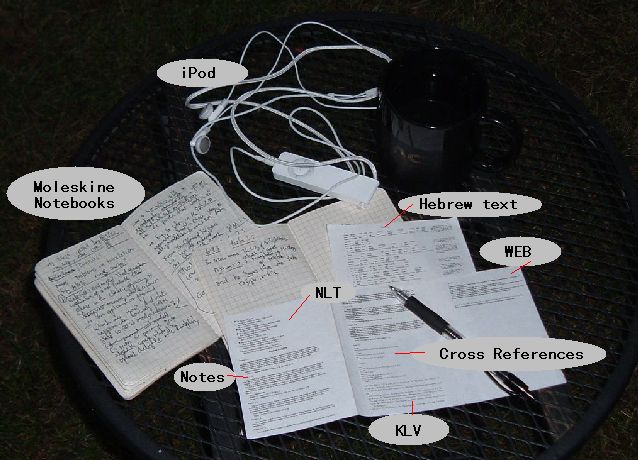
Here's a trivial example of traveling light (yes, this is kind of the excuse for this "holiday travels" podcast) - here's how I work on my Bible studies for these podcasts. I'm fortunate to have plenty of resources - from commentaries and different translations, to a Biblical Encyclopedia. But (considering that I commute to work by bicycle) it isn't practical to carry them wherever I go. I've posted a picture at KlingonWord.org of what I use - take a look; I've found a way to carry "just what I need" in my pocket.


What do you need to work on your podcast? Posted by Hello

Here's what I use to work on the Klingon word from the Word podcasts:


  • Moleskine Notebooks to write in
  • References printed out:

    • Hebrew Text
    • Three translations NLT, WEB, KLV
    • Reference Notes
    • Cross References


The core is, that I use the tools put together by the Crosswire Bible Society. Using their Sword Project, or the Online Bible, I copy into a word processor several translations of the text. I also copy some cross-references and notes from another Bible tool. I print this all small enough that it folds neatly into my pocket note book. Put together, in a package smaller than a passport, I have just enough to take a moment - whenever I have a moment - to work on my studies.

Oh, I'm probably too proud of my mini-Bible library. I enjoy it, and it (for me) is a practical way to do my Bible studies. But in truth, it is so hard to "travel light." I'm at a time in life where I am anticipating the "empty nest" and a house that is too big and filled with far more than I need. We need to pray that God gives us not just what we need - but the wisdom to know what we DON'T.

And traveling light is what we need to do, because we've got a promise that, in the long run, we have nothing to worry about:

'ach nej wa'Dich joH'a' Kingdom, je Daj QaQtaHghach; je Hoch Dochvammey Dochmey DichDaq taH nobpu' Daq SoH as QaQ.

But seek first God's Kingdom, and his righteousness; and all these things will be given to you as well. Matthew 6:33